Master Comparison Table
| Feature | Mini Facelift | SMAS Facelift | Deep Plane Facelift | Mid-Facelift |
|---|---|---|---|---|
| Zone addressed | Lower face / jawline | Lower face + neck | Lower face + midface + neck | Cheeks / midface only |
| Tissue plane | Superficial SMAS (plication) | On / within SMAS | Below SMAS — deep plane | Varies by technique |
| Retaining ligaments | No release | Partial / no release | Full release | Partial (technique-dependent) |
| Midface correction | None | Limited | Excellent | Excellent — targeted |
| Neck correction | Minimal | Good | Excellent | None |
| Anesthesia | Local / twilight | General / deep sedation | General / deep sedation | General / deep sedation |
| Operating time | 1.5–2.5 hrs | 3–4 hrs | 4–6 hrs | 2–3 hrs |
| Social downtime | 1–2 weeks | 2–3 weeks | 2–4 weeks | 2–3 weeks |
| Results longevity | 5–7 years | 7–12 years | 10–15 years | 5–10 years |
| US cost (approx.) | $6,000–$12,000 | $10,000–$20,000 | $15,000–$30,000+ | $8,000–$18,000 |
| Turkey cost (approx.) | $2,500–$5,000 | $4,000–$8,000 | $6,000–$10,000 | $3,000–$7,000 |
| Surgeon availability | Widely available | Most facial plastic surgeons | Specialist subset | Experienced subset |
Mini Facelift — At a Glance
The mini facelift uses short incisions in front of the ear to tighten the lower face and early jowling with local or twilight anesthesia. It is the least invasive surgical facelift option, with the shortest recovery and lowest cost — but also the most limited scope and shortest longevity.1
Best for: Mild to moderate early jowling, good skin elasticity, patients in their 40s to early 60s who do not yet have significant midface or neck concerns.
Not appropriate for: Significant tissue descent across multiple zones; moderate-to-advanced neck laxity; significant midface descent.
Mini Facelift: Complete GuideSMAS Facelift — At a Glance
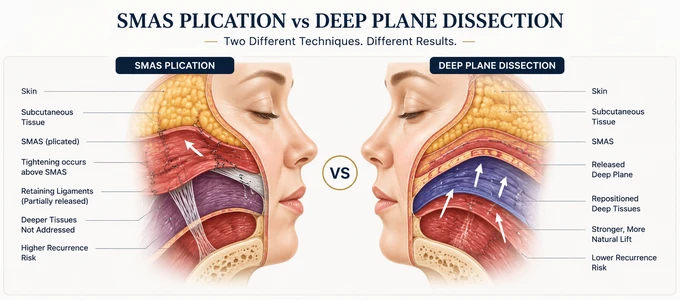
The SMAS facelift is the most widely performed full facelift technique worldwide. It works on the fibrous muscular layer beneath the skin — either folding it (plication), overlapping it (imbrication), or removing a strip (SMASectomy) — to produce natural, longer-lasting correction of the lower face and neck.2
Best for: Moderate jowling, lower face descent, and neck laxity; patients who need more than a mini can achieve but do not have significant midface concerns.
Not appropriate for: Significant midface descent — a deep plane technique addresses this more effectively.
SMAS Facelift: Complete GuideDeep Plane Facelift — At a Glance
The deep plane facelift dissects below the SMAS into the deep plane, releasing the zygomatic, masseteric, and mandibular retaining ligaments. This allows the surgeon to reposition the entire composite tissue — SMAS, fat, and skin — as one unit, producing the most natural and longest-lasting results of any facelift technique.3
Best for: Significant aging across multiple zones — jowling, midface descent, deep nasolabial folds, and neck laxity together; patients who want the most comprehensive and durable result.
Trade-off: Longer operating time, longer recovery, higher cost, and requires a surgeon specifically trained in the technique. A 2024 systematic review and meta-analysis comparing SMAS and deep plane techniques6 provides detailed comparative safety and efficacy data.
Deep Plane Facelift: Complete GuideMid-Facelift — At a Glance
The mid-facelift targets the middle third of the face — the cheeks, malar area, and nasolabial folds — by repositioning the descended malar fat pad.5 It is rarely performed as a standalone procedure; most patients who need midface correction also benefit from lower facelift or eyelid surgery simultaneously.
Best for: Isolated midface descent with a relatively preserved lower face; patients having simultaneous lower blepharoplasty; as a component of a combined procedure.
Note: A deep plane facelift addresses the midface and lower face simultaneously — for many patients with both concerns, it is the more efficient single-procedure choice.
Mid-Facelift: Complete GuideWhich Technique Is Right for You?
The correct technique is determined by anatomy — where aging is occurring and how significantly — not by preference. Use this as a starting framework before your surgical consultation:
| Your primary concern | Consider |
|---|---|
| Mild jawline softening, early jowling, good skin quality | Mini facelift |
| Moderate jowling + neck laxity, no significant midface concern | SMAS facelift |
| Significant jowling + midface descent + deep nasolabial folds + neck | Deep plane facelift |
| Flattened cheeks + malar hollowing, preserved lower face | Mid-facelift (standalone or with blepharoplasty) |
| Significant aging across all zones including midface | Deep plane or mid + lower facelift combined |
| Mild aging, not ready for surgery | Non-surgical options (thread lift, fillers, RF) |
This table is a guide, not a diagnosis. Tissue quality, skin elasticity, medical history, and the specific distribution of descent all factor into the correct choice. A board-certified surgeon's in-person assessment is required to make this determination accurately.
Am I a facelift candidate?Cost Comparison by Technique & Country
| Technique | United States | United Kingdom | Turkey |
|---|---|---|---|
| Mini Facelift | $6,000–$12,000 | £5,000–£9,000 | $2,500–$5,000 |
| SMAS Facelift | $10,000–$20,000 | £8,000–£16,000 | $4,000–$8,000 |
| Deep Plane Facelift | $15,000–$30,000+ | £12,000–£22,000 | $6,000–$10,000 |
| Mid-Facelift | $8,000–$18,000 | £6,000–£14,000 | $3,000–$7,000 |
Turkey often offers these techniques at substantially lower prices than the US or UK. Published ASPS statistics provide general US fee context, but exact quotes vary by surgeon, facility, anesthesia, and scope.4 The price difference may reflect operating costs and local market structure, but it does not prove equal outcome quality by itself. Compare itemized pricing alongside surgeon credentials, facility accreditation, and aftercare structure.
Full cost breakdown by procedureGetting It Done in Turkey
All facelift techniques covered in this guide are performed in Turkey by board-certified surgeons. The key differences when choosing internationally:
- SMAS and mini facelifts — widely available; easier to find experienced surgeons
- Deep plane facelift — requires a surgeon specifically trained in the technique; verify deep plane volume specifically, not just general facelift experience
- Mid-facelift — ask whether the surgeon performs it standalone or as part of a combined approach, and which technique they use
Frequently Asked Questions
-
An SMAS facelift tightens the fibrous layer beneath the skin on its surface. A deep plane facelift dissects below the SMAS, releasing the facial retaining ligaments entirely and repositioning the full composite of tissue as one unit. Deep plane produces more comprehensive midface correction and longer-lasting results (10–15 years vs 7–12), but requires more specialist training, longer operating time, and slightly more recovery.23
-
For patients with significant midface descent, deep jowling, or deep nasolabial folds, the additional cost is generally justified by more comprehensive correction and longer-lasting results. For patients whose concerns are mainly in the lower face and neck without significant midface involvement, a well-executed SMAS facelift can produce equivalent results at lower cost and with slightly shorter recovery.
-
A mini facelift suits mild to moderate early jawline aging with good skin elasticity — typically patients in their 40s to early 60s. A full facelift (SMAS or deep plane) is appropriate when aging is moderate to significant across multiple zones — jowling, cheek descent, and neck laxity together. A surgeon's in-person assessment determines which approach matches your specific anatomy; the choice cannot be made from photos or age alone.
-
Deep plane facelift has the longest-lasting results of any surgical facelift technique — typically 10 to 15 years. SMAS facelifts average 7 to 12 years; mini facelifts 5 to 7 years. Longevity also depends on individual factors: skin quality, genetics, sun protection habits, and smoking history all play a significant role.3
-
Facelift techniques are not combined with each other — a surgeon chooses one approach for the facelift itself. However, a facelift is commonly combined with adjacent procedures in the same session: neck lift, fat grafting (to restore volume), lower blepharoplasty (eyelid surgery), or brow lift — each addressing a different zone. Combining procedures in one session is generally more efficient than staging them separately.