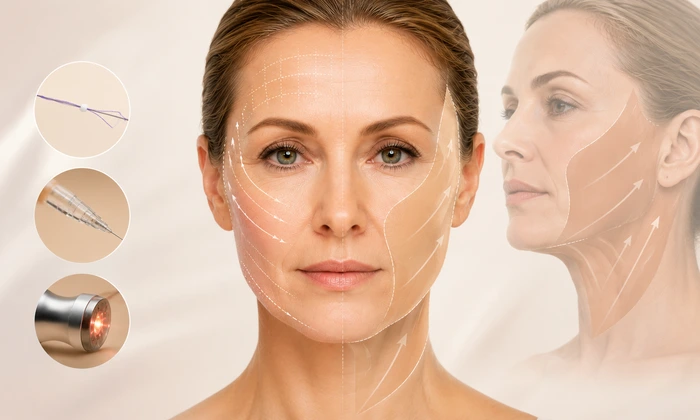
What "Non-Surgical Facelift" Really Means
"Non-surgical facelift" is a marketing term, not a medical one. No single non-surgical treatment replicates what a facelift does.1 The phrase is used to describe a range of minimally invasive procedures — thread lifts, dermal fillers, radiofrequency, ultrasound — each of which addresses specific aspects of facial aging in limited ways.
Understanding what each option can and cannot do is essential to setting realistic expectations. Non-surgical treatments are genuinely useful for the right patient and the right concern. The problem arises when they are presented as equivalent alternatives to surgery for patients whose degree of aging requires structural correction.
The fundamental distinction: surgical facelifts reposition descended tissue and release retaining ligaments — they address the structural cause of aging. Non-surgical options improve the surface appearance (skin quality, volume, mild tightening) without changing the underlying structure.
Thread Lifts
A thread lift uses absorbable suture threads inserted under the skin to physically lift and reposition facial tissue.2 The threads have small barbs or cones that grip the tissue; as they absorb over months, they stimulate collagen production in the treated area.
| Feature | Thread Lift |
|---|---|
| What it addresses | Mild to moderate skin laxity; early jowling; brow, midface, or neck soft tissue |
| How it works | Absorbable threads (PDO, PLLA, PCL) physically lift tissue and stimulate collagen |
| Downtime | Minimal — 2 to 5 days; mild swelling and bruising |
| Results last | 1 to 2 years typically; collagen effect may persist slightly longer |
| Best for | Mild to moderate laxity; patients not ready for or suitable for surgery |
| Not appropriate for | Significant tissue descent; advanced jowling; substantial neck laxity |
| Risks | Thread migration, dimpling, asymmetry, infection (rare), visible thread under skin |
Thread lifts are a genuine option for the right patient — mild laxity, good skin quality, limited expectations. They are not appropriate as a substitute for surgical facelift when tissue descent is significant; the threads cannot achieve the structural repositioning that surgery provides.
Thread lift vs mini facelift: which is right?Dermal Fillers & the "Liquid Facelift"
Dermal fillers — most commonly hyaluronic acid — restore lost volume, soften folds, and improve facial contour through injection rather than incision.3 A "liquid facelift" is a marketing term for a combination of fillers placed strategically across multiple areas in one session.
| Feature | Dermal Fillers |
|---|---|
| What they address | Volume loss; nasolabial folds; tear trough; lip lines; cheek projection; jawline definition |
| How they work | Injectable gel (HA, PLLA, CaHA) adds volume or stimulates collagen at injection site |
| Downtime | Minimal — bruising and swelling possible for a few days |
| Results last | 6 to 18 months depending on product and area; collagen-stimulating fillers up to 2 years |
| Best for | Volume loss; mild fold softening; structural definition in specific areas |
| Not appropriate for | Significant tissue descent — adding volume to descended tissue can worsen appearance |
| Risks | Bruising, asymmetry, filler migration, overcorrection, vascular occlusion (rare but serious) |
An important nuance: when the primary problem is tissue descent rather than volume loss, adding filler can worsen the appearance — it adds bulk to tissue that is already in the wrong position. A thorough assessment by an experienced injector or surgeon identifies whether the concern is volume-driven or descent-driven before treatment.
Energy-Based Skin Tightening
Radiofrequency (RF) and focused ultrasound devices deliver energy beneath the skin to stimulate collagen remodelling and mild tissue contraction.4 Common categories include monopolar RF, fractional RF microneedling, and high-intensity focused ultrasound (HIFU).
| Device Category | Mechanism | Realistic Result | Longevity |
|---|---|---|---|
| HIFU (focused ultrasound) | Targets SMAS layer with focused heat; stimulates collagen | Mild skin tightening; modest lift in appropriate candidates | 1–2 years; maintenance needed |
| Monopolar RF | Bulk heating of deeper dermis and subdermis | Mild skin tightening and contour improvement | 1–2 years |
| RF microneedling | Fractional RF via needles into dermis | Skin quality, texture, mild laxity improvement | 6–18 months per session |
Energy-based devices produce genuine improvement in skin quality and mild laxity — particularly for patients with early aging and good underlying structure.4 The results are subtle compared to surgery and require maintenance sessions. They do not reposition tissue; they improve the quality and firmness of what is already there.
At-Home Treatments: What the Evidence Shows
The market for at-home "facelift" devices (microcurrent, LED, consumer RF) and skincare products is large and claims are often exaggerated. An honest summary:
- Microcurrent devices — can improve muscle tone and skin appearance with consistent use; effect is temporary and requires daily maintenance; not a lift
- LED therapy — some evidence for skin quality improvement (collagen stimulation, inflammation reduction); no lifting effect
- Consumer RF devices — lower-powered versions of clinical RF; mild skin quality improvement possible; not comparable to clinical treatments
- Topical "facelift" creams — no topical product can replicate the structural correction of any injectable or device treatment, let alone surgery; moisturisers and SPF have real benefit for skin health and aging prevention
At-home options are useful for skin maintenance and gradual improvement — not for correcting established structural aging.
How Results Compare to Surgery
| Approach | Tissue descent correction | Volume restoration | Skin tightening | Longevity | Downtime |
|---|---|---|---|---|---|
| Surgical facelift | Excellent | Partial (with fat grafting) | Good | 7–15 years | 2–4 weeks |
| Thread lift | Mild | None | Mild | 1–2 years | 2–5 days |
| Dermal fillers | None | Excellent | None | 6–18 months | Minimal |
| HIFU / RF devices | None | None | Mild–moderate | 1–2 years | None–minimal |
Who Non-Surgical Options Are Right For
Non-surgical treatments are genuinely appropriate when:
- Aging is mild — early laxity, volume loss, skin quality concerns without significant tissue descent
- Volume loss is the primary driver — hollowed cheeks, thinned lips, under-eye hollowing without significant descent
- The patient is not yet a surgical candidate — too young, insufficient aging to warrant surgery
- The patient cannot undergo surgery — health conditions, medications, or recovery constraints make surgery impractical
- As a complement to surgery — fillers and skin treatments often extend and enhance surgical results
Non-surgical options are not appropriate as the sole treatment when significant tissue descent is present, multiple facial zones are affected, or when previous non-surgical treatments have produced insufficient improvement. In these cases, surgery is the appropriate next step.
Am I a surgical facelift candidate?Cost Comparison: Non-Surgical vs Surgical
Non-surgical treatments appear less expensive upfront but require repeat sessions. Over time, the cumulative cost frequently exceeds a one-time surgical procedure:
| Treatment | Cost per session | Frequency | 5-year cumulative cost |
|---|---|---|---|
| Dermal fillers (full face) | $2,000–$5,000 | Every 9–18 months | $8,000–$25,000+ |
| Thread lift | $1,500–$4,500 | Every 1–2 years | $4,500–$12,000 |
| HIFU / RF treatment | $1,500–$4,000 | 1–2× per year | $7,500–$20,000+ |
| Mini facelift (Turkey) | $2,500–$5,000 | Once (5–7 yrs) | $2,500–$5,000 |
| Full facelift (Turkey) | $4,000–$10,000 | Once (7–15 yrs) | $4,000–$10,000 |
This is not an argument that surgery is always the better financial choice — for patients with mild aging who genuinely benefit from non-surgical options, the above represents legitimate value. The point is that non-surgical treatments are not categorically cheaper; long-term costs need to be considered alongside short-term convenience.
Full facelift cost guideFrequently Asked Questions
-
Non-surgical options can produce real, visible improvements for the right patient — particularly for mild aging, volume loss, or skin laxity. However, no non-surgical treatment can replicate the structural correction of a surgical facelift: they cannot reposition significantly descended tissue or release the retaining ligaments that cause advanced aging. For mild concerns, they are a genuine option; for significant aging across multiple facial zones, surgery remains the only durable solution.
-
Longevity varies by treatment: dermal fillers last 6 to 18 months; thread lifts typically 1 to 2 years; energy-based skin tightening (RF, ultrasound) 1 to 2 years with maintenance sessions.2 All require repeat treatments to sustain results, unlike surgical facelifts which produce durable correction lasting 7 to 15 years from a single procedure.5
-
For the right patient — mild to moderate skin laxity with good underlying tissue quality — a thread lift can produce a visible, natural-looking improvement with minimal downtime. Results typically last 1 to 2 years. Thread lifts are not appropriate as substitutes for surgical facelifts in patients with significant tissue descent; threads cannot reposition the SMAS layer or release retaining ligaments the way surgery can.
-
A liquid facelift is a marketing term for a combination of dermal fillers injected strategically across multiple facial areas to restore volume, soften folds, and improve contour. It addresses volume loss and mild surface changes well, but does not lift descended tissue or address the structural causes of aging that a surgical facelift corrects. The term has no standardised medical definition.
-
Surgery becomes the more appropriate option when tissue descent is the primary driver of aging (not volume loss), when multiple facial zones are affected, when previous non-surgical treatments have produced insufficient improvement, or when the patient wants durable results without ongoing repeat maintenance. A surgeon's in-person assessment clarifies whether the degree of aging warrants a surgical approach. Am I a surgical candidate? →