What Is the SMAS Layer?
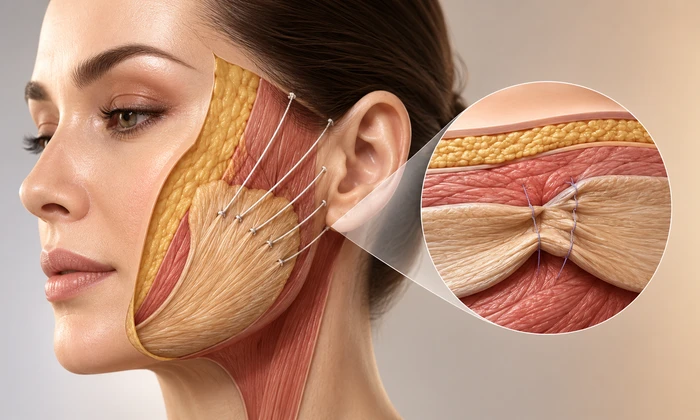
The SMAS — Superficial Musculoaponeurotic System5 — is a fibrous muscular sheet that lies between the skin and the deeper facial structures. It connects to the platysma muscle in the neck and acts as the structural scaffolding of the lower face.
As the face ages, the SMAS weakens and descends. This is the primary structural cause of jowling, deepened nasolabial folds, and neck laxity — not simply the stretching of skin. Older "skin-only" facelifts tried to compensate by placing the skin under high tension, which produced the tight, windswept look associated with outdated techniques. The introduction of SMAS-based surgery in the 1970s changed this: by addressing the structural layer directly, surgeons could produce more natural results with far less skin tension.
How an SMAS Facelift Works
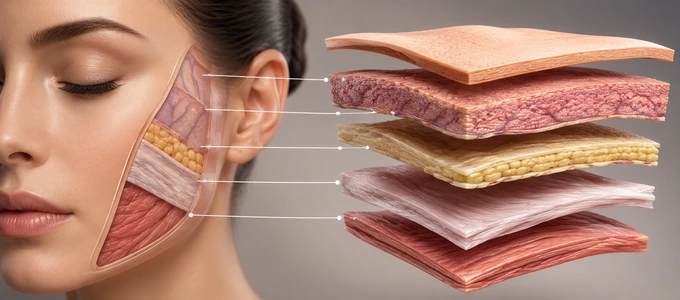
A standard SMAS facelift6 takes 3 to 4 hours and is performed under general anesthesia or deep sedation in an accredited surgical facility. The general steps:
- Incisions are placed in front of and behind the ear, often extending into the temporal hairline
- The skin is elevated to expose the underlying SMAS layer
- The surgeon tightens the SMAS using one of several techniques (see below)
- The skin is redraped over the repositioned deeper tissue and trimmed conservatively
- Incisions are closed with fine sutures; drains are sometimes placed and removed within 24–48 hours
Because the deeper tissue bears the structural correction, the skin requires minimal tension — which is why SMAS facelift results look more natural than skin-only approaches and last significantly longer.
Plication, Imbrication & SMASectomy — What's the Difference?
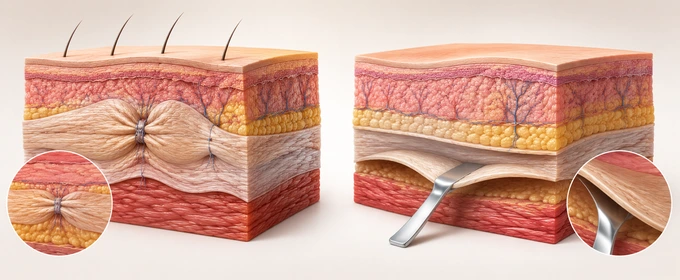
Surgeons use different methods to address the SMAS, and the right choice depends on tissue thickness, the degree of correction needed, and surgical preference. A comprehensive systematic review of 6,086 patients across all SMAS techniques4 reported over 85% patient satisfaction — with complication rates varying by technique:
| Technique | What Happens | Best For | Notes |
|---|---|---|---|
| Plication | SMAS is folded onto itself and sutured without cutting | Thinner SMAS, moderate aging | Simpler; no SMAS entry; lower risk profile |
| Imbrication | Overlapping SMAS layers are sutured after partial separation | Moderate laxity, slightly thicker tissue | More correction than plication; moderate complexity |
| SMASectomy | A strip of SMAS is excised; edges are sutured | Thicker SMAS, more correction needed | Direct lifting force; more dissection involved |
Most patients are unaware of which SMAS technique their surgeon uses — and outcomes between the three are often similar in skilled hands. The key question to ask a surgeon is how they approach the SMAS and why they choose one method over another for a specific anatomy.
Who Is a Good Candidate?
An SMAS facelift is typically appropriate for patients who have:
- Moderate jowling — tissue descending below the mandible, loss of jawline definition
- Deepened nasolabial folds — the lines running from the nose to the corners of the mouth
- Early to moderate neck laxity — looseness in the neck skin or early platysmal banding (often addressed simultaneously with a neck lift component)
- Good general health — no uncontrolled medical conditions; non-smoker or willing to stop well in advance
- Realistic expectations — understands surgery restores a younger version of the same face, not a different face
When SMAS Is Better Than a Mini Facelift
A mini facelift is appropriate for mild, early aging — primarily those with limited jowling and good skin quality. When laxity is more pronounced, or when neck involvement is significant, an SMAS facelift provides the scope of correction a mini procedure cannot achieve.
When a Deep Plane May Be More Appropriate
Patients with significant midface descent — flattened cheeks, deep malar groove, descended malar fat pad — may not achieve adequate correction from an SMAS-level procedure. A deep plane facelift, which releases the facial retaining ligaments entirely, addresses the midface more comprehensively. A surgeon's in-person assessment is the only reliable way to determine which approach is right for a specific anatomy.
Read: Deep Plane Facelift — Complete GuideSMAS vs Deep Plane Facelift
| Feature | SMAS Facelift | Deep Plane Facelift |
|---|---|---|
| Tissue plane | On or within the SMAS | Below the SMAS (deep plane) |
| Retaining ligaments | Partial or no release | Full release |
| Midface correction | Limited | Excellent — repositions malar fat pad |
| Result naturalness | Good | Better — tissue moves as one unit |
| Operating time | 3–4 hours | 4–6 hours |
| Recovery | 2–3 weeks social | 2–4 weeks social |
| Results longevity | 7–12 years | 10–15 years |
| Surgeon availability | Most facial plastic surgeons | Specialist subset |
| Cost (US) | $10,000–$20,000 | $15,000–$30,000+ |
Results & How Long They Last
An SMAS facelift produces natural-looking rejuvenation of the lower face and neck — addressing jowls, mandibular definition, and neck laxity. Because the deeper tissue absorbs the structural correction, skin tension is low and the result does not appear "pulled."
Published outcomes indicate average longevity of 7 to 12 years1, with some patients maintaining results beyond that. The key factors influencing how long results last:
- Skin quality and genetics (intrinsic aging rate)
- Sun exposure and UV protection after surgery
- Smoking — significantly accelerates facial aging
- Significant weight fluctuations post-surgery
- Skincare regimen and collagen support over time
Aging continues after surgery — the result is a consistently younger-looking version of how you would have appeared without the procedure.
Compare longevity across all facelift typesRecovery Timeline
SMAS facelift recovery is slightly less intensive than deep plane due to the less extensive dissection, but still requires dedicated downtime. Here is what to expect:
| Stage | What to Expect | Key Actions |
|---|---|---|
| Days 1–3 | Peak swelling and bruising; bandaging; drains if placed | Head elevation 30–45°, rest, low-sodium diet |
| Days 4–7 | Swelling begins to subside; sutures partially removed; numbness normal | Follow-up visit; gentle cleansing permitted |
| Weeks 2–3 | Most bruising resolved; many patients comfortable in public | Short walks; avoid heat, sun, strenuous activity |
| Weeks 4–6 | Light exercise resumes; residual firmness and tightness ongoing | Scar care begins; avoid contact sports |
| Months 3–4 | Swelling fully resolved; final result visible; scars fading | Sun protection on scars; routine skincare |
Risks & Complications
SMAS facelift is considered a safe procedure when performed by a trained surgeon in an accredited facility. Risks are similar across facelift techniques:
| Complication | Frequency | Notes |
|---|---|---|
| Hematoma | 1–3%2 | Most common complication; requires drainage if significant; usually within 24–48 hours post-op |
| Temporary numbness | Common | Around incision sites and cheeks; typically resolves over weeks to months |
| Infection | <1% | Treated with antibiotics; surgical revision rarely needed |
| Permanent nerve injury | <1%3 | Facial motor nerve damage causing lasting weakness; a meta-analysis across SMAS techniques found permanent injury well below 1% |
| Visible scarring | Uncommon | Well-placed incisions heal well; hypertrophic scarring more common in certain skin types |
| SMAS suture irregularity | Rare | Palpable suture knots under skin; usually resolves or can be corrected |
How Much Does an SMAS Facelift Cost?
| Country | Typical Range | Notes |
|---|---|---|
| United States | $10,000 – $20,000 | Major metro areas at the high end; mid-market cities lower |
| United Kingdom | £8,000 – £16,000 | London private clinics typically £12,000+ |
| Turkey | $4,000 – $8,000 | Often all-inclusive (surgery + accommodation + transfers) |
| Mexico | $6,000 – $12,000 | Popular destination for US patients seeking cost savings |
| Spain / Eastern EU | €8,000 – €15,000 | Varies significantly by country and city |
SMAS facelifts are more widely performed than deep plane procedures, which means cost is somewhat more competitive. The difference between US and Turkey pricing reflects operating costs — not outcome quality, provided surgeon credentials and facility accreditation are properly verified.
Read the full SMAS facelift cost breakdown Considering Turkey? Read our full patient guideFrequently Asked Questions
-
Yes — an SMAS facelift works on the fibrous muscular layer beneath the skin, producing more natural and longer-lasting results than older skin-only techniques. It has replaced the skin-only facelift as the standard approach for most full facelift procedures. Whether it is right compared to other modern techniques (deep plane, mini) depends on the individual patient's anatomy and goals.
-
An SMAS facelift works on the surface of or within the SMAS layer. A deep plane procedure dissects below the SMAS, releasing the retaining ligaments that anchor descended tissue. Deep plane provides more comprehensive midface correction and typically longer results (10–15 years vs 7–12), but requires more specialist training, longer operating time, and slightly more recovery. For patients whose primary concern is the lower face and neck — without significant midface descent — an SMAS facelift may produce equivalent outcomes.
-
Most patients maintain significant results for 7 to 12 years. Longevity depends on skin quality, genetics, sun protection habits, and smoking history. Aging continues after surgery — the result is a consistently younger version of how you would have aged without it. A good skincare regimen and sun protection help extend results.
-
Plication folds the SMAS onto itself and sutures it without cutting — a simpler technique with a lower risk profile, suitable for thinner SMAS tissue. SMASectomy removes a strip of SMAS, providing a more direct lifting effect and often used when the tissue is thicker. Both can produce excellent results in the right patient; the choice is based on anatomy, not a quality ranking.
-
Yes. SMAS facelift is the most commonly performed full facelift technique worldwide, so qualified surgeons are widely available in Turkey. The key is verifying that the surgeon has specific facelift experience — not just general plastic surgery — along with board certification and a JCI-accredited facility. See our surgeon selection guide →