



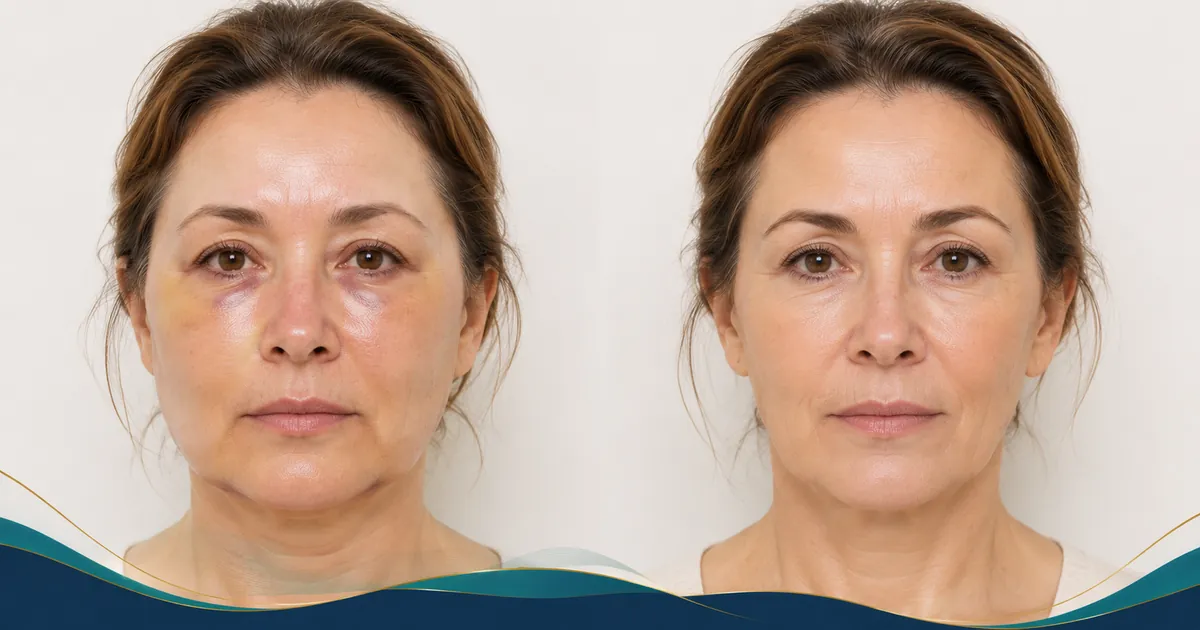
The First 48 Hours
The first two days are the most medically managed phase of recovery. Most SMAS and deep plane patients stay one night in the facility; mini facelift patients are typically discharged the same day.1 Key priorities: head elevation at 30–45° (including while sleeping), cold compresses around (not on) incisions, and rest.
Swelling and bruising begin appearing within hours of surgery and continue building until the peak on days 2–3. This is expected and does not indicate a problem. Pain is typically described as tightness and pressure rather than sharp pain — well managed with prescribed analgesia.
Week 1: Managing the Peak
Days 2–3 are usually the worst visually — peak swelling, bruising fully visible. From day 3–4, swelling begins a gradual, non-linear decline. By day 5–7, most patients have a follow-up appointment for dressing change and partial suture removal.
Numbness around the incision areas and into the neck is normal — temporary disruption of superficial nerve fibres. Most patients feel comfortable at home but are not ready for public appearance.
1-Week Post-Op Deep Plane Facelift: What's NormalWeeks 2–4: Returning to Life
The most visible swelling and bruising resolve during weeks 2–3 for most patients. Sutures are fully removed by week 2. Many feel comfortable returning to desk work and social activities during this window, though residual swelling is still present to the patient (even if not to others). Light exercise typically resumes around week 3–4.
Months 2–6: Final Results
Subtle swelling continues resolving over months 2–6. Scar lines — initially red or pink and slightly raised — gradually fade and flatten. The final result of the facelift becomes apparent around 6 months post-op. Sun protection on scars throughout this period is essential to prevent permanent pigmentation.
When to Call Your Surgeon Immediately
- Rapidly expanding swelling on one side only — key sign of haematoma2; requires urgent drainage
- Increasing pain after day 3 — pain should be declining; worsening suggests infection or haematoma
- Skin that looks dark, purple or blistered — possible skin necrosis
- Fever above 38°C / 100.4°F — possible infection
- Significant asymmetry in facial movement — possible nerve injury requiring assessment3
Recovery by Procedure Type
| Milestone | Mini Facelift | SMAS Facelift | Deep Plane |
|---|---|---|---|
| Peak swelling | Days 2–3 | Days 2–4 | Days 3–5 |
| Suture removal | Days 5–7 | Days 7–10 | Days 7–14 |
| Return to desk work | Days 7–10 | Days 10–14 | Days 14–21 |
| Social presentability | Week 1–2 | Week 2–3 | Week 2–4 |
| Light exercise | Week 2–3 | Week 3–4 | Week 4–6 |
| Final results | Month 3–4 | Month 4–6 | Month 4–6 |
Frequently Asked Questions
-
Most patients are socially presentable within 2–3 weeks. Subtle swelling continues resolving for 3–6 months, but most people cannot detect it past week 3–4. Final results are visible at 4–6 months.
-
Most patients describe discomfort as tightness and pressure rather than sharp pain. Prescribed pain medication manages it effectively during the first few days. Pain that worsens after day 3 warrants contact with your surgeon — it's not a normal part of recovery.
-
Most surgeons recommend waiting at least 7–10 days. Sutures should be removed and healing assessed before departure. For international patients, this is a critical planning factor — flying before clearance increases complication risk.