What Is a Full Facelift?
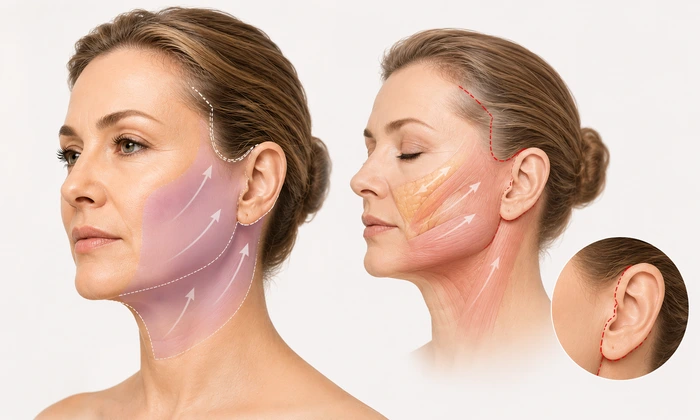
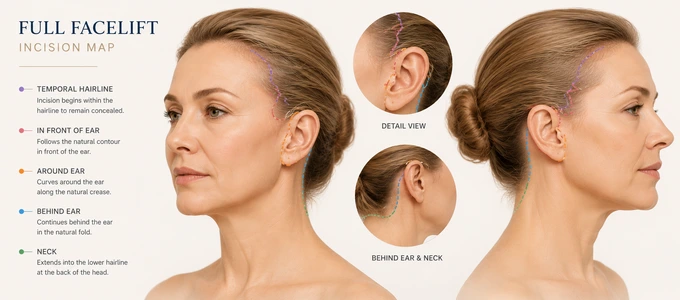
A full facelift — medically termed rhytidectomy — is a surgical procedure that addresses the lower two-thirds of the face: the cheeks, jowls, mandibular border, and neck.1 It uses longer incisions than a mini facelift, typically running in front of and behind the ear and extending into the temporal hairline, and works on the SMAS layer or deeper to reposition descended facial tissue.
The term "full facelift" is not a single specific technique — it refers to the scope of correction rather than a named procedure. In practice, a full facelift is performed using either an SMAS-based technique (plication, imbrication, or SMASectomy) or a deep plane technique, each of which addresses different tissue layers and produces slightly different results.
"Full facelift" is often used to distinguish the procedure from a mini facelift (limited lower face only) or a mid-facelift (cheeks only). When someone asks whether they need a "full facelift," they are typically asking whether their degree of aging warrants a comprehensive procedure rather than a more limited one.
Full Facelift Techniques: SMAS vs Deep Plane
The two primary approaches used in full facelift surgery differ in how deeply they work and how much of the facial anatomy they address:
| Feature | SMAS Facelift | Deep Plane Facelift |
|---|---|---|
| Tissue plane | On or within the SMAS layer | Below the SMAS — into the deep plane |
| Retaining ligaments | Partial or no release | Full release |
| Midface correction | Limited | Excellent |
| Operating time | 3–4 hours | 4–6 hours |
| Recovery | 2–3 weeks social | 2–4 weeks social |
| Results longevity | 7–12 years2 | 10–15 years3 |
| Surgeon availability | Most facial plastic surgeons | Specialist subset |
Both are full facelift procedures — the choice depends on the patient's anatomy, degree of aging, and whether midface correction is needed. A surgeon's in-person assessment determines which technique is most appropriate.
Deep Plane Facelift: Complete Guide SMAS Facelift: Complete GuideFull Facelift vs Mini Facelift
The most common question patients have is whether they need a full facelift or whether a mini facelift will suffice. The distinction comes down to the degree and distribution of aging:
| Feature | Mini Facelift | Full Facelift |
|---|---|---|
| Zone addressed | Lower face and jawline only | Lower two-thirds: cheeks, jowls, jaw, neck |
| Incision length | Short — in front of ear only | Longer — front + behind ear + hairline |
| Anesthesia | Local / twilight sedation | General anesthesia or deep sedation |
| Operating time | 1.5–2.5 hours | 3–6 hours |
| Recovery | 1–2 weeks social | 2–4 weeks social |
| Results last | 5–7 years | 7–15 years |
| Best for | Early / mild aging | Moderate to significant aging across multiple zones |
A mini facelift is a genuine procedure with real results — but it is scope-limited. When jowling is pronounced, neck laxity is significant, or when multiple facial zones need correction, a full facelift provides correction a mini procedure cannot achieve.
Mini Facelift: Complete GuideWho Is a Good Candidate?
A full facelift is appropriate for patients who have:
- Moderate to significant jowling — tissue clearly descended below the mandible, loss of jawline definition
- Cheek descent — flattened midface, descended malar fat pad
- Neck laxity — loose skin, platysmal banding, or early "turkey neck" appearance
- Aging across multiple facial zones — not limited to a single area addressable by a more targeted procedure
- Good general health — no uncontrolled cardiovascular, diabetes, or clotting conditions; non-smoker or willing to stop well before and after surgery
- Realistic expectations — understands a facelift restores a younger version of the same face, not a fundamentally different appearance
Age Range
Most full facelift patients are between 45 and 70, though the procedure is appropriate at any age when the degree of aging warrants it. Younger patients occasionally present with premature aging due to genetics, significant sun damage, or weight loss — tissue quality and degree of descent are more relevant than the number itself. Patients over 70 are evaluated individually, with particular attention to general health and healing capacity.
When a Full Facelift Is Not the Right Choice
For patients with mild, early aging concentrated in the jawline — particularly those in their early 40s with good skin elasticity — a mini facelift or less invasive approach may produce equivalent results with significantly less recovery. For patients whose primary concern is the cheeks and nasolabial folds with a preserved lower face, a mid-facelift or deep plane procedure specifically may be more targeted. A surgeon's assessment identifies which approach matches the patient's specific anatomy.
How the Procedure Works
A full facelift takes 3 to 6 hours depending on technique (SMAS or deep plane) and whether a neck lift is included simultaneously. It is performed under general anesthesia or deep sedation in an accredited surgical facility:
- Incisions are placed in front of and behind the ear, extending into the temporal hairline and sometimes the lower scalp
- The skin is elevated to expose the SMAS layer
- The SMAS is addressed — either tightened on its surface (SMAS techniques) or the surgeon dissects below it to release retaining ligaments (deep plane)
- Descended tissue is repositioned in a vertical or oblique vector — upward, not backward
- The neck is addressed — often including platysma muscle tightening and removal of excess neck skin
- Skin is redraped conservatively with minimal tension; excess is trimmed
- Incisions are closed with fine sutures; drains are sometimes placed and removed within 24–48 hours
Neck Lift — Often Combined
A neck lift (platysmaplasty) is frequently performed simultaneously with a full facelift. When significant neck laxity, platysmal banding, or excess neck skin is present, addressing the neck as part of the same procedure is both more efficient and produces a more harmonious result than treating it separately. Many surgeons include a neck lift component as standard in their full facelift approach.
Results & How Long They Last
A full facelift produces comprehensive rejuvenation of the lower face and neck — restoring jawline definition, reducing jowling, improving cheek contour, and addressing neck laxity. Because modern techniques work on the SMAS or deeper layers rather than just tightening skin, results look natural: the face appears as a younger version of itself rather than "pulled" or operated.
Results longevity depends primarily on the technique used:
- SMAS-based techniques — typically 7–12 years2
- Deep plane technique — typically 10–15 years3
Additional factors that influence how long results last: genetics and intrinsic aging rate, UV exposure and sun protection, smoking (significantly accelerates aging), significant weight changes after surgery, and ongoing skincare regimen.
Compare longevity across all facelift typesRecovery Timeline
| Stage | What to Expect | Key Actions |
|---|---|---|
| Days 1–3 | Peak swelling and bruising; bandaging; drains if placed; tightness and pressure | Head elevation 30–45°, rest, low-sodium diet |
| Days 4–7 | Swelling begins to subside; sutures partially removed; numbness around incisions normal | Follow-up visit; gentle cleansing permitted |
| Weeks 2–3 | Most bruising resolved; many comfortable in public; residual tightness normal | Short walks; avoid heat, sun, strenuous activity |
| Weeks 4–6 | Light exercise resumes; firmness and numbness gradually resolving | Scar care begins; avoid contact sports |
| Months 3–6 | Swelling fully resolved; final result visible; scars fading | Sun protection on scars; routine skincare |
Risks & Complications
Full facelift surgery is considered safe when performed by a trained specialist in an accredited facility. Risks are described across facelift techniques in the peer-reviewed complication literature:45
| Complication | Frequency | Notes |
|---|---|---|
| Hematoma | 1–3% | Most common complication; requires drainage if significant; typically within 24–48 hours post-op |
| Temporary numbness | Common | Around incisions and cheeks; usually resolves over weeks to months |
| Prolonged swelling | Common | More extensive procedures take longer to fully resolve — 3 to 6 months for final result |
| Infection | <1% | Treated with antibiotics; surgical revision rarely needed |
| Permanent nerve injury | <1% | Facial motor nerve damage causing lasting weakness; rare in specialist hands |
| Visible scarring | Uncommon | Well-placed incisions heal well; hypertrophic scarring more common in certain skin types |
| Skin irregularity | Rare | Contour irregularities from uneven dissection; correctable in most cases |
How Much Does a Full Facelift Cost?
Full facelift pricing covers a wide range depending on technique, surgeon experience, facility, and geographic market. Deep plane procedures typically cost more than SMAS due to longer operating time and greater specialist demand.
| Country | SMAS Range | Deep Plane Range | Notes |
|---|---|---|---|
| United States | $10,000–$20,000 | $15,000–$30,000+ | Major metros at the high end; mid-market cities lower |
| United Kingdom | £8,000–£16,000 | £12,000–£22,000 | London private clinics at the high end |
| Turkey | $4,000–$8,000 | $6,000–$10,000 | Often all-inclusive (surgery + accommodation + transfers) |
| Mexico | $6,000–$12,000 | $8,000–$14,000 | Popular destination for US patients |
| Spain / Eastern EU | €8,000–€15,000 | €10,000–€18,000 | Varies significantly by country and city |
The price difference between the US and Turkey can reflect operating costs and local market structure, but outcome quality still depends on surgeon credentials, facility standards, and published outcomes evidence.6
Full facelift cost breakdown by procedure Considering Turkey? Read our full patient guideFrequently Asked Questions
-
A full facelift (rhytidectomy) addresses the lower two-thirds of the face — cheeks, jowls, jawline, and neck — using a SMAS-based or deep plane technique. It involves longer incisions than a mini facelift, extends behind the ear and into the hairline, and is performed under general anesthesia or deep sedation. It is the most comprehensive surgical approach to lower and mid facial rejuvenation.
-
A mini facelift uses shorter incisions and targets only the lower face and jawline, with 1 to 2 weeks of social downtime. A full facelift uses longer incisions, addresses the entire lower two-thirds of the face including the neck, and requires 2 to 4 weeks of downtime. Full facelift results last significantly longer — 7 to 15 years versus 5 to 7 for a mini. For patients with mild, early aging, a mini facelift may produce equivalent results; for moderate to significant aging across multiple zones, a full facelift is typically needed.
-
A full facelift typically lasts 7 to 15 years depending on technique. SMAS-based procedures average 7 to 12 years; deep plane procedures average 10 to 15 years. Longevity is influenced by skin quality, genetics, sun protection habits, smoking, and post-surgery skincare. Aging continues after surgery — the result is a consistently younger-looking version of how the face would have aged without it.23
-
Most full facelift patients are between 45 and 70, though the procedure is appropriate at any age when the degree of aging warrants it. Tissue quality and the distribution of aging across facial zones are more relevant than age alone. A board-certified surgeon's in-person assessment is the only reliable way to determine whether a full facelift, a less extensive procedure, or a combination approach is most appropriate for a specific patient.
-
Yes. Turkey has qualified facial plastic surgeons who perform full facelifts — both SMAS and deep plane — at 60 to 70 percent lower cost than the US or UK. The key is selecting a surgeon with specific full facelift experience, verified board certification, and a JCI-accredited facility. See our surgeon selection guide →