Credentials That Actually Matter
Turkey has many surgeons marketing themselves as facelift specialists. The credentials that actually distinguish a qualified surgeon from a general aesthetic practitioner are specific — and verifiable.
Board Certification (TPCD)
The Turkish Board of Plastic, Reconstructive and Aesthetic Surgery (TPCD — Türk Plastik, Rekonstrüktif ve Estetik Cerrahi Derneği) is the primary national specialty board. A surgeon certified by TPCD has completed an accredited residency in plastic surgery and passed board examinations.3 This is the baseline credential you should confirm for any surgeon in Turkey.
This is different from a general surgeon, dermatologist, or other specialty practitioner who has taken cosmetic procedure courses. In Turkey, as in many countries, non-specialists can legally perform certain aesthetic procedures — but they are not board-certified plastic surgeons.
International Membership: ISAPS and EBOPRAS
Membership in ISAPS (International Society of Aesthetic Plastic Surgery) or EBOPRAS (European Board of Plastic Reconstructive and Aesthetic Surgery) can support credential verification when combined with specialty training and case experience. ISAPS maintains a public directory searchable by country and name.1
Subspecialty Focus in Facial Surgery
Within plastic surgery, there is a meaningful difference between a surgeon who focuses primarily on facial procedures — facelifts, rhinoplasty, eyelid surgery — and one whose practice is evenly split across body, breast, and facial work. A facelift is a complex facial anatomy procedure. Volume and focus in facial surgery specifically matters for outcome quality.
When reviewing a surgeon's profile, look for a breakdown of their procedures. A surgeon who performs 100+ facelifts per year is meaningfully different from one who performs 10–20 as part of a broad general cosmetic practice.
Facility Accreditation
JCI (Joint Commission International) accreditation is the recognized international standard for hospital quality and safety. JCI-accredited hospitals in Turkey have undergone rigorous external evaluation of processes, staffing, equipment, and safety protocols. Accreditation does not guarantee outcomes but verifies that infrastructure and process standards meet an internationally recognized benchmark.
Not all good facilities are JCI-accredited, and JCI accreditation alone does not guarantee surgeon quality. But for international patients without local knowledge, JCI accreditation is a meaningful filter.
How to Verify a Surgeon's Qualifications
| Credential | How to Verify |
|---|---|
| TPCD board certification | Ask the surgeon or clinic directly; a genuine board member should be listed on the TPCD website or affiliated university/hospital directory |
| ISAPS membership | Search the public ISAPS member directory at isaps.org — searchable by country and name |
| EBOPRAS certification | EBOPRAS maintains a public register of certified surgeons at ebopras.eu |
| University/hospital affiliation | Search the surgeon's name on the affiliated university or hospital website — academic positions are publicly listed |
| JCI facility accreditation | JCI publishes a searchable directory of all accredited organizations at jointcommissioninternational.org |
Do this verification yourself — do not rely solely on information provided by the clinic or coordinator. A few minutes of independent verification is a fundamental due diligence step.
What to Expect in a Pre-Operative Consultation
A proper pre-operative consultation for a facelift is not a sales call. It should be a substantive medical conversation in which the surgeon reviews your photos and health history, explains what technique they recommend and why, sets realistic expectations, and answers your questions without time pressure.
For international patients, this consultation should take place via video call before any booking or payment is made. If a clinic does not offer a direct video consultation with the surgeon — or offers only a coordinator call — that is a meaningful red flag.
In a proper consultation, the surgeon should:
- Review your facial anatomy from photos you've submitted
- Recommend a specific technique and explain why it's appropriate for your anatomy and goals
- Discuss realistic outcomes — including what the procedure cannot achieve
- Explain the anesthesia approach and what that involves
- Walk through the recovery timeline and what you'll need to plan for
- Address your questions clearly, without deflection
Questions to Ask Your Surgeon in Consultation
- How many facelifts do you perform per year, and what proportion are deep plane / SMAS / mini? — Volume and case mix indicate specialization.
- Which technique do you recommend for my anatomy, and why? — The answer should be specific to you, not a generic package pitch.
- What results are realistic for my specific degree of aging? — A honest answer includes what surgery cannot correct.
- What are the main risks for my situation specifically? — Risk profile varies by patient health, age, smoking history, and technique.
- Can I see before-and-after photos of your facelift patients — specifically cases similar to mine?
- Who will be my anesthesia provider, and what type of anesthesia is planned?
- What is the plan if I have a complication after I return home?
- What is your revision policy?
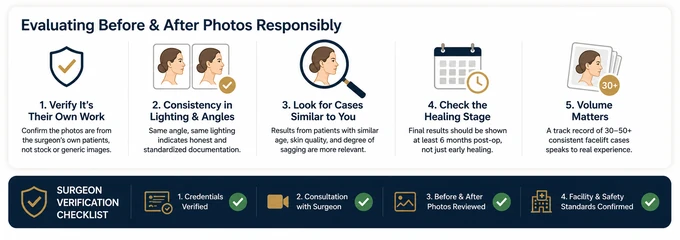
Evaluating Before & After Photos Responsibly
Before-and-after photos are a standard part of evaluating a surgeon, but they require careful interpretation:
- Verify they are the surgeon's own work: Ask specifically whether the photos are from the surgeon's own patients. Some clinics use stock or generic portfolio images not attributable to their surgeon.
- Look for consistency in lighting and angles: Dramatic lighting changes between before and after photos can exaggerate results. Standardized photography (same angle, same lighting) is a sign of honest documentation.
- Look for cases similar to your anatomy: Photos from patients with very different starting points (degree of sagging, age, skin quality) tell you less about what your result might look like.
- Check the healing stage: A photo taken at 6 weeks post-op will show significantly different results than one taken at 12 months. Final results should be documented at least 6 months after surgery.
- Volume matters: A surgeon who can show 30–50 consistent facelift cases has demonstrated a track record. A portfolio of 5–6 exceptional cases tells you less.
Red Flags: Clinics and Surgeons to Avoid
The medical tourism market in Turkey ranges from internationally accredited hospitals with specialist surgeons to high-volume aesthetic brokers with opaque standards. CDC advises medical tourists to consider facility and treating-professional risks before traveling.2 These warning signs should prompt you to look elsewhere:
- No named surgeon before booking: You should know exactly who will operate on you before any payment or commitment. "You'll meet your surgeon on arrival" is not acceptable.
- No direct consultation with the surgeon: If all communication is through a patient coordinator and you cannot speak directly with the surgeon before booking, walk away.
- Pressure to book quickly: "This price expires in 48 hours" or "we only have one slot left this month" are sales tactics. A reputable surgical practice does not use them.
- Generic or unverifiable before-and-after photos: If photos cannot be attributed to the specific surgeon, they are meaningless for evaluation.
- Vague credentials: "Board-certified" without specifying the board, or credential claims that cannot be independently verified, are red flags.
- Package pricing with no breakdown: You should know exactly what is and isn't included — surgeon fee, anesthesia, facility, accommodation, transfers — before committing.
- No revision or aftercare policy: What happens if you need a follow-up or revision? The answer should be clear and written.
- No post-operative support for international patients: A reputable clinic provides a contact point and clear protocol for complications after you return home.