What Is a Mini Facelift?
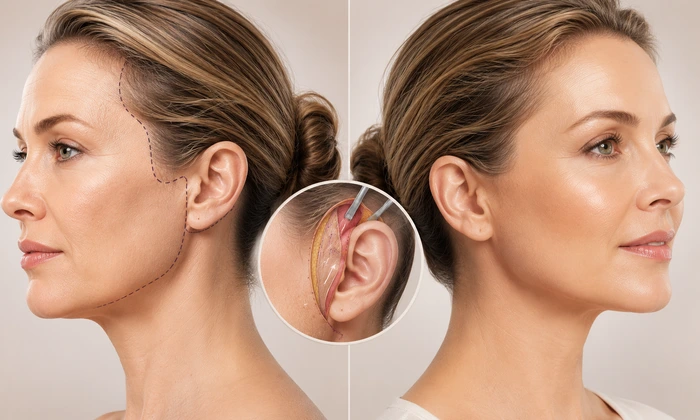
A mini facelift — also called a "short scar facelift" or S-lift — is a scaled-down version of a full facelift (rhytidectomy)1. It uses shorter incisions, typically just in front of the ear rather than extending behind it and into the hairline, and involves less tissue dissection than an SMAS or deep plane procedure. The most widely studied short-scar technique is the MACS (Minimal Access Cranial Suspension) lift, which has been the subject of systematic review across 18 years of published literature.4
The scope of correction is more focused: a mini facelift primarily addresses the lower face, including mild to moderate jowling and early jawline sagging. It does not address significant midface descent, deep nasolabial folds, or significant neck laxity the way a full facelift can.
Mini vs Full Facelift
| Feature | Mini Facelift | Full Facelift (SMAS / Deep Plane) |
|---|---|---|
| Incision length | Short — in front of ear only | Longer — front and behind ear, into hairline |
| Tissue addressed | Lower face and jawline | Full lower face, midface, and neck |
| Anesthesia | Local or twilight sedation | General anesthesia or deep sedation |
| Operating time | 1.5–2.5 hours | 3–6 hours |
| Recovery | 1–2 weeks social | 2–4 weeks social |
| Results last | 5–7 years | 7–15 years |
| US cost | $6,000–$12,000 | $10,000–$30,000+ |
Who Is a Good Candidate?
A mini facelift is most appropriate for patients who have:
- Early to moderate jowling — jawline definition beginning to soften, tissue just starting to descend
- Good skin elasticity — skin that still has reasonable recoil and quality
- No significant midface descent — cheeks and malar area largely in good position
- Limited neck concerns — mild laxity at most; significant neck sagging requires a more extensive procedure
- Preference for shorter recovery — life or work circumstances that make 2–4 weeks of downtime impractical
A mini facelift is generally less suitable for patients with advanced aging across multiple facial zones. These patients tend to achieve better, longer-lasting results with a SMAS or deep plane technique — even accounting for the additional recovery.
Age Considerations
Mini facelifts are often described as ideal for patients in their 40s to early 60s, but age alone is not the determining factor. While ISAPS global survey data2 show facelift surgery is most commonly performed on patients aged 51–64, tissue quality and the specific degree of sagging matter more than the number. A 65-year-old with mild jawline laxity may be a better mini facelift candidate than a 50-year-old with significant midface descent.
Am I a good facelift candidate?The Procedure & Anesthesia Options
A mini facelift typically takes 1.5 to 2.5 hours and is performed in an outpatient surgical facility. The general steps:
- Short incisions placed just in front of the ear (and sometimes slightly behind)
- Skin is elevated to access the underlying SMAS layer
- The SMAS is tightened — usually through plication (folding and suturing)
- Excess skin is trimmed conservatively
- Incisions are closed with fine sutures
Anesthesia
Mini facelifts are commonly performed under local anesthesia with twilight sedation — meaning the patient is relaxed and comfortable but not fully unconscious. Recovery from sedation is typically faster and involves less nausea than general anesthesia. Some surgeons prefer general anesthesia for all facelift procedures; the choice depends on surgeon preference and patient health factors.
Learn more about twilight sedationResults & Realistic Expectations
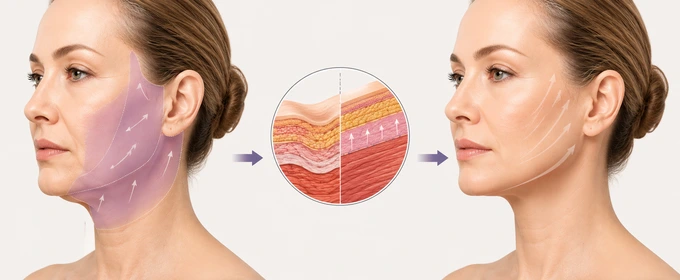
A mini facelift can produce noticeable improvement in jawline definition and early jowling. What it reliably addresses:
- Mild to moderate jowling
- Early softening of the mandibular border
- Minor neck laxity directly beneath the chin
What it generally cannot address reliably:
- Significant midface descent or deep nasolabial folds
- Significant neck skin laxity (a separate neck lift component may be needed)
- Under-eye hollows or cheek volume loss — these require fillers or fat grafting
The goal is a natural result that looks like a younger version of the same person — not a dramatically different appearance. Results that are well-matched to the patient's anatomy and degree of aging produce the highest satisfaction.
See before & after expectations by procedure typeHow Long Do Results Last?
Mini facelift results typically last 5 to 7 years. They are shorter-lasting than the 7–12 years documented for SMAS3 or deep plane procedures because the surgery addresses less tissue and does not release the deep retaining ligaments that anchor descended facial structures.
Some patients choose to repeat the procedure after several years, or transition to a more comprehensive approach as aging progresses. Aging continues after surgery regardless of technique — the result is a consistently younger-looking version of how the face would have aged without it.
Compare longevity across all facelift typesRecovery & Downtime
Mini facelift recovery is meaningfully faster than full facelift due to the less extensive dissection, with lower overall complication rates5 than more extensive techniques. A 2025 systematic review6 confirms that hematoma remains the most common complication across all facelift types but is rare with proper patient selection:
| Stage | What to Expect | Key Actions |
|---|---|---|
| Days 1–2 | Swelling and mild bruising; bandaging; rest at home | Head elevation, ice packs (as directed), rest |
| Days 3–5 | Swelling peaks then begins to subside; numbness normal | Follow-up visit; gentle cleansing |
| Days 5–7 | Sutures partially removed; most patients feel markedly better | Short gentle walks; avoid heat and sun |
| Week 2 | Most visible bruising resolved; many return to work or social activities | Continue avoiding strenuous activity |
| Weeks 3–6 | Light exercise resumes; residual firmness settling | Scar care begins; sun protection on incisions |
How Much Does a Mini Facelift Cost?
| Country | Typical Range | Notes |
|---|---|---|
| United States | $6,000 – $12,000 | Major cities at the high end; mid-market practices lower |
| United Kingdom | £5,000 – £9,000 | London private clinics typically £7,000+ |
| Turkey | $2,500 – $5,000 | Often all-inclusive (surgery + accommodation + transfers) |
| Mexico | $3,000 – $6,000 | Popular destination for US patients |
Mini facelifts cost less than full facelift procedures across all markets due to shorter operating time and simpler technique. As with all facelift types, the price difference between the US and Turkey reflects operating costs — not outcome quality, provided surgeon credentials are properly verified.
Read the full mini facelift cost breakdown Considering Turkey? Read our full patient guideFrequently Asked Questions
-
A mini facelift uses shorter incisions and addresses only the lower face and jawline. A full facelift uses longer incisions and addresses the full lower two-thirds of the face, including the midface and neck. Full facelifts produce more comprehensive, longer-lasting results but require more recovery time and are more expensive.
-
Results typically last 5 to 7 years, though this varies by individual. Mini facelift results are shorter-lasting than SMAS or deep plane procedures because the surgery addresses less tissue and does not release the deep retaining ligaments. Sun protection, not smoking, and a good skincare regimen help extend results.
-
For the right candidate — early jawline sagging, good skin elasticity, limited midface concerns — a mini facelift provides real, natural-looking results with less downtime and cost than a full facelift. For patients with more advanced aging, a SMAS or deep plane facelift may deliver better long-term value despite the higher upfront cost and recovery.
-
Most mini facelift patients are in their 40s to early 60s, but candidacy depends on tissue quality and degree of aging rather than age alone. A 65-year-old with mild jawline concerns may be a better candidate than a 50-year-old with significant midface descent. A board-certified surgeon's in-person assessment is the only reliable way to determine candidacy.
-
Yes. Mini facelifts are commonly performed under local anesthesia with twilight sedation — the patient is relaxed and comfortable but not fully unconscious. Recovery from sedation is typically faster and involves less nausea than general anesthesia. Some surgeons prefer general anesthesia for all facelift procedures depending on patient factors and surgical scope. Learn more about twilight sedation →