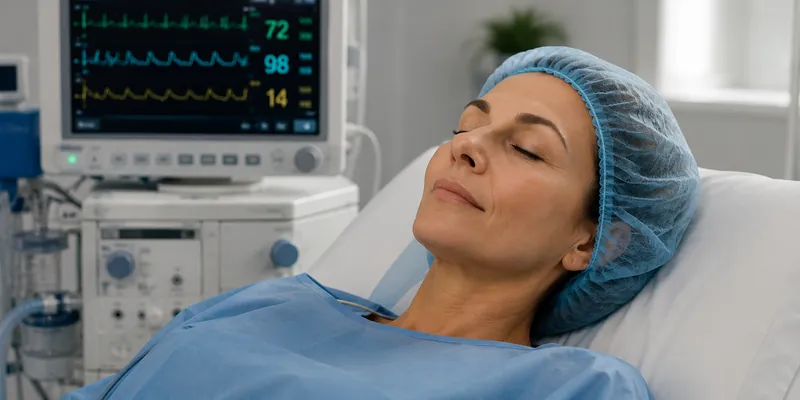
What Is Twilight Sedation?
Twilight sedation is one of several types of anesthesia used in surgery4 — a form of intravenous sedation that produces a dissociative state — reduced consciousness, pain suppression, and amnesia — without completely suppressing the protective airway reflexes that general anaesthesia eliminates. The technical term is monitored anaesthesia care (MAC) or conscious sedation, though "conscious" is somewhat misleading: most patients are deeply unresponsive during the procedure itself.
The depth of sedation is titrated throughout the procedure. A qualified anaesthesiologist adjusts the drug delivery rate to maintain the correct level — deep enough that you feel nothing, but not so deep that breathing support (intubation) becomes necessary. This is what distinguishes it from general anaesthesia, where intubation is standard.
Twilight vs General Anaesthesia
| Feature | Twilight Sedation (MAC) | General Anaesthesia (GA) |
|---|---|---|
| Consciousness level | Deeply sedated; responsive to cues | Fully unconscious |
| Airway management | Natural airway; no intubation | Intubated; ventilator-assisted |
| Memory of procedure | None to minimal | None |
| Nausea after | Less common | More common (up to 30%3 of patients; higher in high-risk groups) |
| Recovery time | Faster (1–2 hrs to discharge-ready) | Longer (2–4 hrs typical) |
| Throat soreness | None | Common (from intubation) |
| Cardiovascular stress | Lower | Higher |
| Suitable for facelift | Mini, SMAS; some deep plane | Deep plane, extended procedures |
Neither option is categorically "safer" — the appropriate choice depends on the procedure length and complexity, patient health factors, and surgeon preference. For shorter procedures in healthy patients, twilight sedation offers meaningful advantages in recovery comfort.
Full comparison: Twilight vs General Anaesthesia for FaceliftHow It Feels & Whether You'll Remember
The experience varies slightly by medication protocol, but most patients describe a progression that goes: drowsiness → heavy-limbed relaxation → no awareness of time passing → waking in recovery. The transition from sedated to awake is typically gradual and gentle rather than abrupt.
Will you feel pain? No. The local anaesthetic injected at the surgical site blocks sensation directly; the sedation medications suppress anxiety and awareness. Some patients have vague sensations of pressure or movement without pain — this is normal and does not indicate inadequate sedation.
Will you talk? You may respond to simple verbal cues from your surgical team ("take a deep breath," "can you hear me?"). Some patients make sounds or brief responses. Most have no memory of any interaction during the procedure. Spontaneous or coherent conversation is uncommon.
Will you remember it? The amnesic component of twilight sedation medications is strong. The vast majority of patients have no memory of the procedure from shortly after sedation begins. Brief flashes of awareness — called light anaesthesia moments — occur rarely and are not associated with pain.
Common Drugs Used
Twilight sedation protocols typically combine two or three agents targeting different aspects of the sedative effect:
| Drug | Class | Role |
|---|---|---|
| Propofol | Sedative-hypnotic | Primary sedation; short-acting, smooth induction and recovery |
| Midazolam | Benzodiazepine | Anxiolysis and amnesia; often given as pre-medication |
| Fentanyl | Opioid analgesic | Intraoperative pain suppression |
| Ketamine (low-dose) | Dissociative anaesthetic | Analgesia and sedation with minimal respiratory depression; sometimes used as adjunct |
| Dexmedetomidine | Alpha-2 agonist | Sedation with preserved respiratory drive; used in some MAC protocols |
The specific combination and dosing is determined by the anaesthesiologist based on patient weight, health status, and the procedure's expected duration. A comprehensive review of MAC protocols and safety1 covers these agents in detail. Patients with known drug sensitivities or current medications should disclose all of these at the pre-operative assessment.
Is Twilight Sedation Dangerous? Risk Profile
For healthy adult patients, twilight sedation has a well-established safety profile. Serious complications are uncommon when administered by a qualified anaesthesiologist using appropriate monitoring (continuous ECG, pulse oximetry, capnography, blood pressure).
The most common side effects are minor: transient nausea, mild dizziness on standing, and short-lived confusion on waking. These typically resolve within 1–2 hours.
Factors that increase risk meaningfully:
- Obesity (BMI >35): Increased risk of airway obstruction and oxygen desaturation during sedation
- Obstructive sleep apnoea: Sedation can suppress the arousal responses that keep the airway open during sleep; requires careful monitoring and may necessitate GA
- Cardiovascular disease: Some sedation agents affect heart rate and blood pressure; pre-operative cardiac assessment may be required
- Severe anxiety or paradoxical drug reactions: Some patients become agitated rather than sedated on benzodiazepines — rare, but requires protocol adjustment
- Non-qualified administrator: MAC must be delivered by a qualified anaesthesiologist or certified nurse anaesthetist with appropriate rescue equipment present
Serious respiratory complications during properly administered MAC are rare in healthy patients (ASA I–II). A large-scale analysis of 13,346 facelift patients2 found that general anaesthesia was associated with increased odds of adverse events compared to sedation-based approaches.
Is Twilight Sedation Dangerous? A Detailed Look at the RisksTwilight Sedation in Facelift Surgery
Twilight sedation is the preferred anaesthetic approach for mini facelifts and for many SMAS facelift procedures. The relatively shorter operative time (1.5–3 hours for mini and SMAS vs 4–6 hours for deep plane) makes it feasible to maintain adequate sedation without the additional complexity of a general anaesthetic.
For deep plane facelifts, most surgeons use general anaesthesia as the default, primarily because of the longer operative time and the need to work in very close proximity to deeper facial nerve branches — where even minor patient movement is problematic. Some experienced surgeons with specialised training in deep plane technique perform it under deep MAC sedation in carefully selected patients, but this is not universal practice.
| Procedure | Typical Anaesthesia | Notes |
|---|---|---|
| Mini Facelift | Twilight sedation (MAC) | Well-suited; short duration (1.5–2 hrs) |
| SMAS Facelift | MAC or GA | Surgeon and patient preference; both common |
| Deep Plane Facelift | General anaesthesia (GA) | Usually GA; some specialists use deep MAC |
| Full Facelift + Neck Lift | General anaesthesia (GA) | Extended operative time requires GA in most cases |
Your surgeon should discuss the anaesthesia plan at your pre-operative consultation. If you have a preference or concerns — particularly around nausea, recovery speed, or specific health factors — raise these early, as they can influence the approach chosen.
Deep Plane Facelift: procedure, recovery & candidacy Mini Facelift: a complete guideFrequently Asked Questions
-
Twilight sedation (also called IV sedation or monitored anaesthesia care) is a state of deep relaxation and pain suppression achieved through intravenous medications. You remain technically conscious but are not aware of pain and will have little or no memory of the procedure.
-
You may respond to simple verbal cues from your surgical team. Some patients make sounds or brief responses. You are unlikely to carry on a coherent conversation, and most patients have no memory of any interactions during the procedure.
-
Twilight sedation has a well-established safety profile for healthy adults. Serious complications are rare when administered by a qualified anaesthesiologist with appropriate monitoring. Risk increases with obesity, sleep apnoea, or cardiovascular disease — conditions that require careful pre-operative assessment and may point toward general anaesthesia instead.
-
Mini facelifts and many SMAS facelift procedures are well-suited to twilight sedation. Deep plane facelifts — which are longer and more technically complex — more commonly require general anaesthesia, though some experienced surgeons perform them under deep sedation in carefully selected patients.