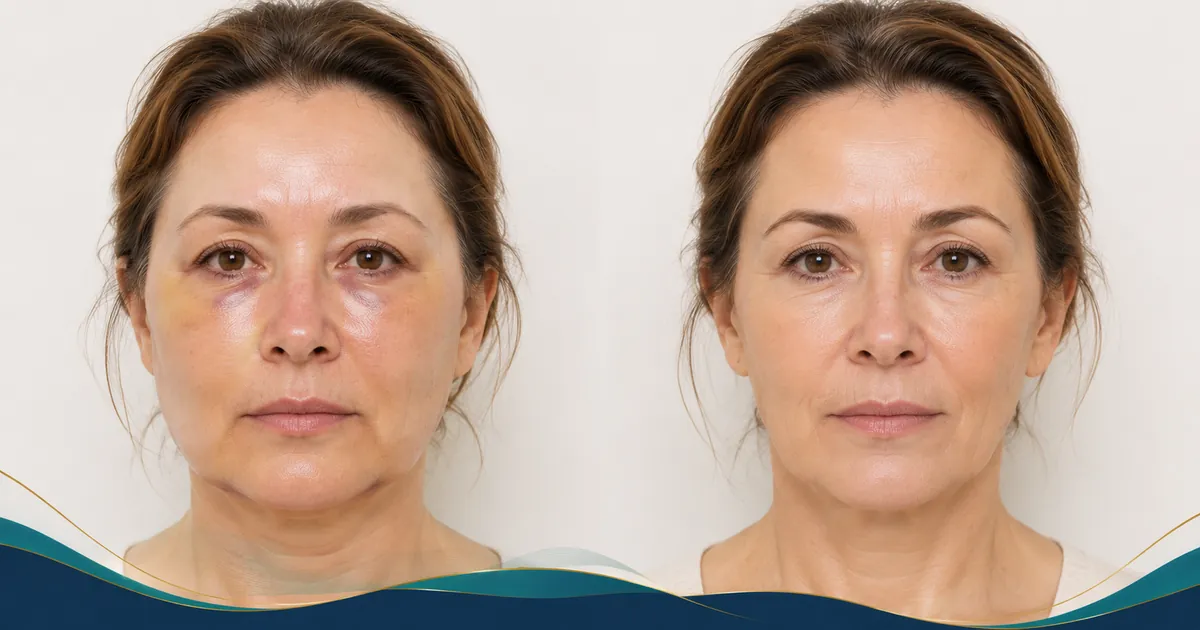
Swelling Timeline: What to Expect Week by Week
Swelling after a facelift follows a predictable pattern. Understanding each phase reduces anxiety and helps you track whether your recovery is on course.
| Timeframe | What Happens | What You'll Notice |
|---|---|---|
| Day 1 | Surgery and immediate post-op swelling begins | Face feels tight and puffy; bandages in place |
| Days 2–4 | Swelling peaks — fluids accumulate at surgery sites | Maximum puffiness; eyes may be partially swollen shut |
| Days 5–7 | Swelling begins to reduce; drains removed (if used) | Face starts to look more recognisable; still swollen |
| Week 2 | Major swelling reduction; bruising fading | Sutures removed; most patients feel less self-conscious |
| Weeks 3–4 | Most visible swelling resolved | Comfortable going out; residual puffiness in cheeks |
| Weeks 5–8 | Continued improvement; firmness softening | Results becoming more natural-looking |
| Months 3–6 | Residual deep tissue swelling resolves | Final contour emerging; under-eye area last to clear |
| Months 6–12 | Full result visible | Scars fading; results at their best |
Note that swelling often feels worse in the mornings when you first wake up. This is normal — fluid accumulates overnight when you are lying down. It will reduce throughout the day as you sit upright and move gently.
Bruising Timeline
Bruising is caused by small blood vessels disrupted during surgery releasing blood into surrounding tissue. It follows a colour-change pattern that most patients find predictable.
| Timeframe | Colour | What's Happening |
|---|---|---|
| Days 1–2 | Red / dark red | Fresh blood under skin |
| Days 3–5 | Purple / blue | Blood losing oxygen |
| Days 5–10 | Green / brown | Haemoglobin breaking down |
| Days 10–14 | Yellow / tan | Final reabsorption stage |
| Weeks 2–3 | Near-normal | Bruising gone or minimal |
Bruising migration: It is normal for bruising to move downward due to gravity over the first week. Discolouration on the neck, jawline, and even upper chest is common — even when facial incisions are healing perfectly. Do not be alarmed if new discolouration appears in these areas in the first week.
How to Reduce Swelling After a Facelift
These measures are backed by clinical evidence and are standard advice from experienced facelift surgeons.
Head Elevation
Keeping your head above your heart reduces the hydrostatic pressure that drives fluid into the face. Sleep on at least two pillows or in a recliner at approximately 30–45 degrees for the first 2 weeks. Avoid lying completely flat, even for naps. This is one of the most important and effective things you can do.
Gentle Activity
Short, gentle walks from day 2 onward improve circulation and help your lymphatic system drain excess fluid. Do not remain sedentary. However, avoid anything that raises your heart rate significantly — even moderate exercise increases blood pressure and prolongs swelling.
Cold Compresses
Cold reduces blood vessel permeability and limits fluid accumulation. Apply for the first 48–72 hours (see protocol below). After this window, cold is less effective and warm compresses may actually help more — ask your surgeon.
Avoid Heat
Hot showers, saunas, steam rooms, and hot weather all dilate blood vessels and increase swelling. Keep showers lukewarm for the first 2 weeks.
No Bending Forward
Bending at the waist (to pick something up, tie shoes, etc.) causes a sharp increase in blood pressure to the head. This is one of the most common causes of increased swelling in the first 2 weeks. Crouch with a straight back instead.
Cold Compress Protocol
Cold compresses are most effective in the first 48–72 hours. After that, the benefit diminishes significantly.
- What to use: Gel ice packs wrapped in a thin cloth, or a bag of frozen peas. Never apply ice directly to the skin.
- Duration: 15 minutes on, 15 minutes off. Do not exceed 20 minutes continuous application.
- Placement: Cheeks, jaw, and neck — not directly over incisions unless your surgeon specifically instructs this.
- Frequency: As often as comfortable during waking hours for the first 48–72 hours.
- After 72 hours: Stop cold compresses unless your surgeon advises otherwise. Some surgeons switch to gentle warmth after day 3–5 to promote circulation.
Do not apply ice directly to skin after a facelift. Skin sensation is temporarily reduced after surgery and you may not feel a cold burn developing. Always use a cloth barrier.
Diet and Hydration Tips
What you eat and drink has a direct effect on how much fluid your face retains.
Low Sodium
Sodium causes the body to retain water. A low-sodium diet — avoiding processed foods, takeaways, soy sauce, cured meats, and added salt — can noticeably reduce facial puffiness. Aim for under 1,500 mg sodium per day for the first 2–3 weeks.
Stay Hydrated
Counterintuitively, drinking plenty of water helps reduce fluid retention. Dehydration causes the body to hold onto fluid. Aim for 2–2.5 litres of water per day.
Anti-Inflammatory Foods
Some foods may help reduce inflammation: pineapple (bromelain enzyme), berries, leafy greens, and omega-3-rich foods like salmon and walnuts. Evidence is modest but these are healthy choices regardless.
Avoid Alcohol
Alcohol dilates blood vessels and significantly increases bruising and swelling. Avoid for at least 2 weeks — ideally 4 weeks post-surgery.
Arnica
Many surgeons recommend arnica tablets or gel to reduce bruising. Some prescribe bromelain supplements. Evidence is mixed but side effects are minimal — check with your surgeon before use.
Lymphatic Drainage Massage
Manual lymphatic drainage (MLD) is a gentle, specialised massage technique that stimulates the lymphatic system to clear fluid from the face more quickly.2 It is used in many facelift recovery programmes, but timing and pressure should be approved by your surgeon.
| Aspect | Details |
|---|---|
| When to start | Week 2 onward — not before (risk of disturbing healing tissue in week 1) |
| Frequency | 2–3 sessions per week for weeks 2–6, then as needed |
| Who should do it | A therapist trained in post-surgical MLD; not a standard massage therapist |
| What to expect | Very light pressure — should feel like skin is gently being stretched, not deep tissue massage |
| Surgeon approval | Always confirm with your surgeon before starting — not all surgeons recommend it |
If you are recovering abroad in Turkey, ask your clinic whether post-op lymphatic drainage is included in your package or available at their facility.
Swelling by Facelift Technique
The amount of swelling you experience depends significantly on which procedure you had.
| Technique | Expected Swelling | Public-Ready Timeframe |
|---|---|---|
| Mini facelift | Moderate — limited dissection | 2–3 weeks |
| SMAS facelift | Moderate–significant | 3–4 weeks |
| Deep plane facelift | Significant — deepest dissection | 3–5 weeks |
| Mid-facelift | Variable — includes cheek work | 3–4 weeks |
Deep plane facelifts involve releasing tissue at a deeper anatomical layer, which causes more tissue disruption and therefore more swelling. The benefit is typically more comprehensive, longer-lasting results — the tradeoff is a more pronounced initial recovery.
Warning Signs: When Swelling Requires Medical Attention
While swelling is normal, certain patterns indicate a complication that requires prompt assessment.
| Warning Sign | Possible Cause | What to Do |
|---|---|---|
| Sudden significant swelling on one side only | Hematoma (blood collection)3 | Contact surgeon immediately — same day |
| Swelling that worsens after day 4–5 | Hematoma, infection, or seroma | Contact surgeon promptly |
| Firm, painful swelling with warmth and redness | Infection | Contact surgeon — may need antibiotics |
| Fluctuant (fluid-filled) lump under skin | Seroma (fluid collection) | Contact surgeon — may need aspiration |
| Fever above 38°C with facial swelling | Infection | Contact surgeon or attend emergency care |
| Skin discolouration becoming darker or blistering | Skin compromise / poor blood supply | Contact surgeon immediately |
Asymmetric, rapidly-worsening swelling is the main danger sign. Normal swelling is bilateral (both sides), diffuse, and gradually improving after day 4. One-sided swelling that increases sharply — especially if accompanied by pain or firmness — should be assessed the same day because hematoma is a recognized facelift complication.3