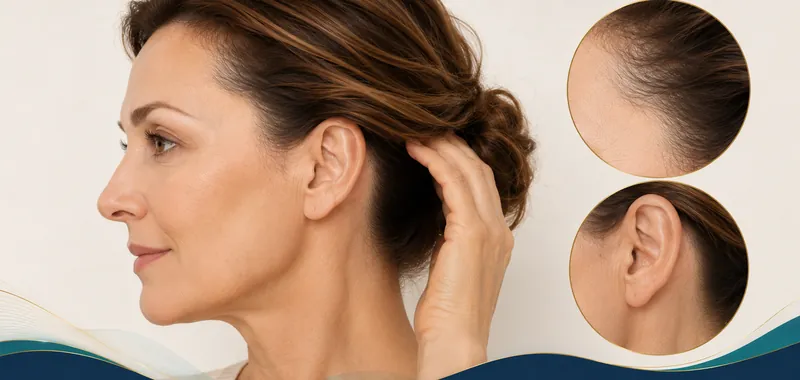
Where Facelift Incisions Are Placed
Facelift incisions follow a path designed to hide within the natural anatomy of the ear and hairline. The standard incision route:
- Temporal scalp: begins 1–2 cm inside the hairline above the ear
- Pre-auricular: runs down in front of the ear, either within the natural crease between ear and cheek (pre-tragal) or just inside the tragus itself (retro-tragal — leaves less visible scarring but requires more precision)
- Around the earlobe: curves under and around the lobule
- Post-auricular: continues up behind the ear
- Posterior scalp: ends within the hairline at the back
If a neck lift or submentoplasty is combined, a small separate incision is placed under the chin (sub-mental incision) — this heals within the natural crease and is rarely visible.
Annotated illustration: facelift incision path around the ear
Incision Placement by Technique
The core incision path is similar across techniques, but there are differences worth knowing:
| Technique | Incision Length | Notable Differences |
|---|---|---|
| Mini facelift | Shorter — typically stops at or just behind the earlobe | Shorter post-auricular component; less posterior scalp involvement |
| SMAS facelift | Standard length — full pre- and post-auricular route | Classic placement; well-established healing pattern |
| Deep plane facelift | Standard to slightly extended | Similar external placement; deeper tissue work does not change incision path |
| Mid-facelift | Variable — may use temporal or intraoral incisions | Some approaches avoid ear incisions entirely |
Scar Healing Timeline
All scars go through predictable biological phases of healing. Facelift scars are no different — what you see at week 4 is not what you will have at month 12.
| Stage | Typical Scar Appearance | What's Happening |
|---|---|---|
| Weeks 1–2 | Closed wound lines; possible crusting or ooze | Initial wound closure and early healing |
| Weeks 3–6 | Pink, slightly raised lines; may feel firm or itchy | Collagen synthesis; remodelling begins |
| Months 2–4 | Pink, may widen slightly; feel like a firm ridge | Collagen remodelling peak; proliferative phase |
| Months 4–9 | Fading to lighter pink or skin tone; flattening | Scar maturation; vascularity decreasing |
| Months 9–18 | Pale, flat, at or below skin surface | Full maturation; scar approaches final appearance |
The timeline varies by individual. Skin type, genetics, age, and adherence to scar care all affect outcomes. Patients with darker skin tones (Fitzpatrick IV–VI) are at higher risk of hyperpigmentation or hypertrophic scarring and should discuss this with their surgeon before surgery.
Scar Care: What Works
The evidence base for scar care interventions is uneven — many popular products lack rigorous evidence. The following have the best support:
Sun Protection (Most Important)
UV exposure is the most reliably damaging thing you can do to a healing scar. Even brief sun exposure on a scar within the first 12 months can cause permanent hyperpigmentation — darkening that does not fade. Apply SPF 50 sunscreen to all scar areas whenever there is any sun exposure, even through windows. This is non-negotiable for 12 months.
Silicone Gel or Sheets
Silicone is one of the most evidence-supported non-surgical interventions for improving scar appearance.1 It works by maintaining hydration in the scar tissue and reducing collagen overproduction. Begin once wounds are fully closed — typically from week 3–4 — and use consistently for 3–6 months. Both gel and sheet forms are effective; sheets may be more practical for larger areas, gel for awkward contours around the ear.
Gentle Massage
Once wounds are fully healed (typically from week 4–6), gentle circular massage of the scar helps soften it and prevent tethering to underlying tissue. Use a small amount of unscented moisturiser or prescribed scar gel. 2–3 minutes per area, twice daily. Do not massage open or incompletely healed wounds.
What Does Not Have Strong Evidence
Vitamin E oil is popular but not well-supported by evidence and can cause contact dermatitis in some patients. Coconut oil, rosehip oil, and similar natural products are not harmful but are not proven scar treatments. Focus on SPF and silicone.
What Affects Scar Quality
Several factors influence how well facelift scars heal:
- Surgeon technique: Tension on the skin closure is the most important controllable factor. Scars heal poorly when closed under tension — experienced facelift surgeons redistribute tension to deeper tissue layers (SMAS, platysma), leaving minimal tension on the skin.3 This is one of the most important reasons to choose a surgeon with extensive facelift-specific experience.
- Incision placement: Whether incisions track within natural creases or stray outside them significantly affects visibility. Pre-tragal vs. retro-tragal placement, hairline vs. within-scalp positioning — these are technique decisions that determine scar outcome.
- Genetics and skin type: Individual healing response varies. Patients prone to keloid or hypertrophic scarring are at higher risk for problematic facelift scars.
- Smoking: Significantly impairs wound healing after facelift surgery and increases the risk of wound dehiscence (opening) and poor scar outcomes.2
- Sun exposure: UV damage to healing scars causes permanent hyperpigmentation.
- Patient adherence: Following wound care instructions, applying silicone, and using SPF consistently all meaningfully affect outcomes.
When Scars Are a Problem
Most facelift scars heal unremarkably with time. The following are signs that a scar may require attention:
- Widening or spreading: A scar that is noticeably widening beyond week 6–8 may indicate excessive tension — contact your surgeon
- Raised, thickened, itchy scar beyond 3 months: May be hypertrophic scarring; treatable with steroid injections, silicone, and pressure therapy
- Dark, raised scar extending beyond the original incision: May be a keloid; requires specialist assessment
- Scar tracking outside natural anatomy (e.g., visible hairline shift): A surgical technique issue — discuss scar revision options with your surgeon after full healing at 12 months
- Tethering or puckering of skin around scar: Can sometimes be improved with massage or minor revision procedures
Scar revision, if indicated, is typically considered no sooner than 12 months post-surgery, when the scar has fully matured.