
What Is a Deep Plane Facelift?
A deep plane facelift6 is a surgical technique that works beneath the SMAS (Superficial Musculoaponeurotic System) — the fibrous muscular sheet between the skin and the deeper facial structures. Rather than tightening only the skin or the SMAS layer itself, a deep plane procedure releases the retaining ligaments that hold the face in a descended position and repositions the entire composite of tissue (SMAS, fat, and skin) as one unit.
The result is a more natural-looking rejuvenation because the surgeon is restoring the face to where it used to be — not just pulling skin tight. There is minimal skin tension, which means less risk of the "windswept" or artificial look associated with older, skin-only techniques.
The technique was first described by Sam Hamra MD in 19901 and has evolved significantly since — including variations like the extended deep plane and composite facelift that address the midface even more comprehensively.
How It Differs From a Traditional (SMAS) Facelift
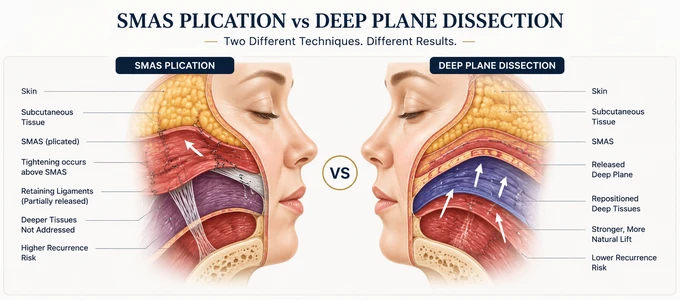
| Feature | SMAS Facelift | Deep Plane Facelift |
|---|---|---|
| Tissue layer worked | On top of or within SMAS (plication/imbrication) | Releases tissue below the SMAS |
| Retaining ligaments | Partial or no release | Full release (zygomatic, masseteric, mandibular) |
| Midface correction | Limited | Excellent — repositions malar fat pad |
| Naturalness of result | Good | Better — moves tissue as one unit, no skin tension |
| Operating time | 3–4 hours | 4–6 hours |
| Recovery | 2–3 weeks social | 2–4 weeks social |
| Results longevity | 7–12 years2 | 10–15 years3 |
| Surgeons who perform it | Most facial plastic surgeons | Specialist subset — fewer surgeons trained in this |
What the "Deep Plane" Actually Refers To
The term "deep plane" refers to the surgical plane of dissection — the space the surgeon works within. In a standard facelift, the surgeon works in the superficial plane above the SMAS. In a deep plane procedure, the dissection goes below the SMAS, into the deep plane, where the facial retaining ligaments attach.
The key ligaments released in a deep plane procedure include:
- Zygomatic ligaments — anchoring the cheek to the cheekbone
- Masseteric ligaments — along the jawline
- Mandibular cutaneous ligaments — contributing to jowl formation
By releasing these ligaments, the surgeon can reposition decades of descended facial tissue back to its original anatomical position — without relying on skin tension to hold the result in place. This is why deep plane results look more natural and last longer.
Who Is a Good Candidate?
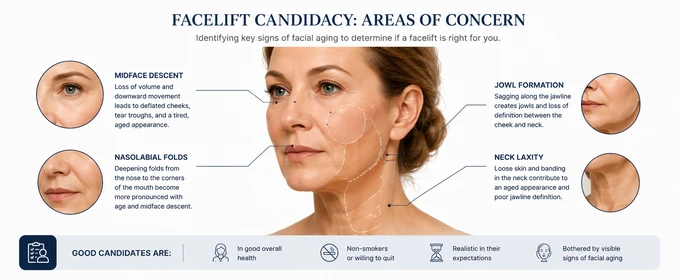
Deep plane facelift candidates typically have one or more of the following:
- Significant midface descent — flattened cheeks, descended malar fat pad
- Deep nasolabial folds — pronounced smile lines that run from the nose to the corners of the mouth
- Jowling — loss of jawline definition, tissue descending below the mandible
- Neck laxity — loose skin and platysmal banding (often combined with a neck lift)
- Good general health — no uncontrolled medical conditions; non-smoker (or willing to stop)
- Realistic expectations — understands surgery restores, not reverses, aging
Deep Plane Facelift in Your 40s
A growing number of patients in their 40s are seeking deep plane surgery, particularly those with early significant midface descent or genetic predisposition to facial aging. At this age, skin elasticity is typically better, which can improve healing and result quality. However, the key question is whether the degree of aging warrants such a comprehensive procedure — a board-certified surgeon can assess whether a less invasive option would achieve similar goals for a given patient.
Read: Deep Plane Facelift in Your 40s — Is It Too Early?How the Procedure Works
A deep plane facelift typically takes 4–6 hours and is performed under general anesthesia or deep sedation in an accredited surgical facility. The general steps:
- Incisions are placed in front of and behind the ear, often extending into the temporal hairline
- Skin is elevated to expose the SMAS layer
- The surgeon dissects below the SMAS into the deep plane
- Retaining ligaments (zygomatic, masseteric, mandibular cutaneous) are carefully released
- The composite tissue flap (SMAS + fat + skin) is repositioned in a vertical or oblique vector — upward and slightly backward
- Excess skin is conservatively trimmed and incisions are closed with fine sutures
Because repositioning occurs at the tissue level, there is minimal tension on the skin itself — which is why results look natural rather than "pulled."
Anesthesia Options
Deep plane facelifts are typically performed under general anesthesia, though some experienced surgeons perform them under deep sedation (twilight) for appropriate candidates. The choice depends on the surgeon's preference, procedure complexity, and patient health factors.
Compare: Twilight Sedation vs General AnesthesiaResults & How Long They Last
Deep plane facelift results are generally considered the most comprehensive and natural-looking of any surgical facelift technique. Because the surgery restores the deep facial architecture rather than just tightening skin, the result does not look "pulled" or artificial — the face looks like a younger version of the same person.
Published research suggests average longevity of 10–15 years — a 30-year retrospective study3 found patients returned for revision after an average of 10.9 years, with younger patients averaging 12.4 years. Factors that influence longevity include:
- Genetics and skin quality
- Sun exposure and UV protection habits
- Smoking status
- Significant weight fluctuations post-surgery
- Overall skincare regimen
Recovery Overview
Deep plane recovery is more intensive than mini or SMAS facelift due to the more extensive dissection involved. Here is what to expect:
| Stage | What to Expect | Key Actions |
|---|---|---|
| Days 1–3 | Peak swelling and bruising; tightness and pressure; drains (if placed) | Head elevation 30–45°, rest, low-sodium diet |
| Days 4–7 | Swelling begins to subside; sutures partially removed; numbness normal | Follow-up visit; gentle cleansing |
| Weeks 2–3 | Most bruising resolves; many comfortable in public | Short walks; avoid heat, sun |
| Weeks 4–6 | Light exercise resumes; residual firmness and numbness ongoing | Avoid strenuous activity; scar care begins |
| Months 3–6 | Swelling fully resolves; final result visible; scars fading | Sun protection on scars; skincare routine |
Risks & Complications
Deep plane facelift is considered a safe procedure when performed by a trained specialist in an accredited facility. As with any surgery, risks exist:
| Complication | Frequency | Notes |
|---|---|---|
| Hematoma | 1–3%4 | Most common complication; requires drainage if significant; typically occurs within 24–48 hours |
| Temporary numbness | Common | Around incision sites; usually resolves over weeks to months |
| Prolonged swelling | Common | More extensive than other techniques; full resolution at 3–6 months |
| Infection | <1% | Treated with antibiotics; surgical revision rarely needed |
| Permanent nerve injury | <1%5 | Facial motor nerve injury causing lasting weakness; a meta-analysis of 15,404 patients found a 0.047% permanent motor nerve damage rate |
| Visible scarring | Uncommon | Well-placed incisions heal well; hypertrophic scarring more common in certain skin types |
How Much Does a Deep Plane Facelift Cost?
| Country | Typical Range | Notes |
|---|---|---|
| United States | $15,000 – $30,000+ | NYC, LA, Miami at the high end; mid-market cities lower |
| United Kingdom | £12,000 – £22,000 | London private clinics typically £18,000+ |
| Turkey | $6,000 – $12,000 | Often all-inclusive (surgery + accommodation + transfers) |
| Mexico | $7,000 – $14,000 | Medical tourism destination for US patients |
| Spain / Eastern EU | €10,000 – €18,000 | Varies widely by country and city |
Deep plane facelifts cost more than SMAS or mini procedures because they require significantly more surgical skill, longer operating time, and are performed by fewer specialists. The price difference between the US and Turkey reflects operating costs — not outcome quality, provided surgeon credentials and facility accreditation are properly verified.
Read the full cost breakdown Considering Turkey? Read our full patient guideFrequently Asked Questions
-
"Better" depends on your degree of aging and goals. For significant midface descent and jowling, deep plane typically produces more comprehensive and longer-lasting results. For mild to moderate concerns, a SMAS or mini facelift may achieve very similar results with less recovery time and cost. Only a surgeon's in-person assessment can determine which technique is right for a specific patient.
-
Age alone doesn't determine candidacy — tissue quality and degree of aging do. Some patients in their 40s are good candidates, particularly those with early significant midface descent. Better skin elasticity in younger patients may produce superior healing. A consultation with a board-certified specialist is the only way to assess this properly.
-
Most patients maintain significant results for 10–15 years. The deep plane technique tends to outlast other facelift approaches because it addresses the structural causes of aging (ligament laxity, tissue descent) rather than just tightening skin. Aging continues after surgery — the result is a younger-looking version of how you would have aged without it.
-
Social downtime is typically 2–4 weeks. Most patients feel comfortable being seen in public by weeks 2–3, though subtle swelling continues resolving for 3–6 months before the final result is fully visible. Deep plane recovery is slightly longer than SMAS due to the more extensive tissue work involved.
-
Yes. Turkey has experienced facial plastic surgeons who perform deep plane facelifts at significantly lower cost than the US or UK. The key is selecting a surgeon with specific deep plane experience — not all plastic surgeons perform this technique. Verifying board certification, ISAPS membership, and seeing actual before-and-after results from the surgeon's own cases are essential steps. See our full Turkey patient guide →