What Is a Mid-Facelift?
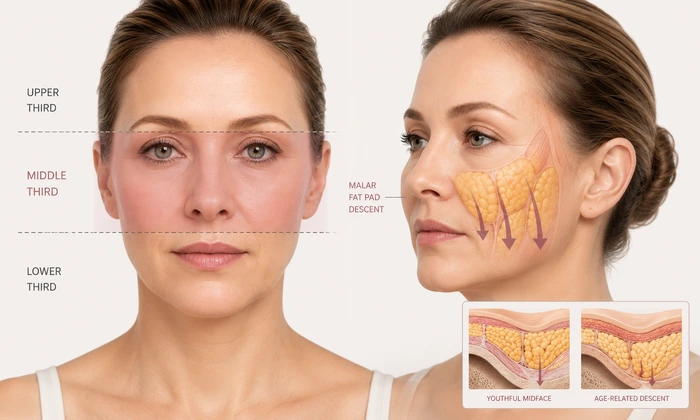
A mid-facelift — also called a midface lift or cheek lift — is a surgical procedure that targets the middle third of the face: the area from the lower eyelids to the corners of the mouth.1 This zone includes the malar (cheek) fat pad, the nasolabial folds, and the tissue below the cheekbones.
Unlike a lower facelift (SMAS or deep plane), which primarily addresses the lower face, jowls, and neck, a mid-facelift focuses specifically on restoring the descended cheek volume and flattened midface that develops with age. As the malar fat pad descends, it creates a hollowed look under the eyes and deepens the nasolabial folds — a mid-facelift repositions this tissue upward and back toward its original position.3
The Middle Third: What Changes With Age
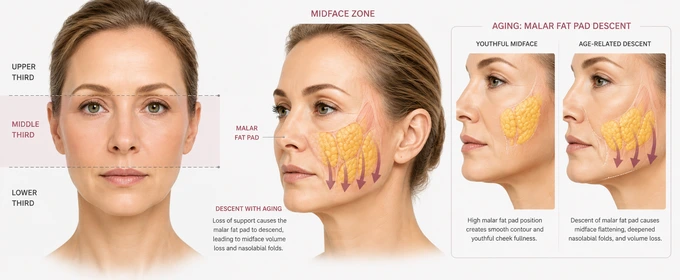
The face is often divided into three zones: upper (forehead and brows), middle (below the eyes to the upper lip), and lower (lower lip to chin, jawline, and neck). Different facelift procedures target different zones.
In the middle third, age-related changes include:
- Malar fat pad descent — the cheek fat compartment slides downward, flattening the cheekbone area
- Deepened nasolabial folds — as cheek volume descends, it accumulates at the nasolabial fold, deepening the crease
- Malar hollowing — the under-eye area appears sunken as the cheek fat moves down
- Loss of ogee curve — the S-shaped contour that defines a youthful cheek is lost
These changes do not respond well to a lower facelift alone, which addresses the jawline and neck but does not reposition midface structures. This is why the mid-facelift exists as a distinct procedure — and why a deep plane facelift, which addresses both the lower face and midface simultaneously, is often considered more comprehensive than a standard SMAS technique.
Surgical Approaches
Several techniques can address the midface, with different incision placements and access routes:1
| Approach | Access Route | Best For | Notes |
|---|---|---|---|
| Endoscopic | Small temporal and oral incisions; camera-assisted | Isolated midface descent; younger patients | Minimal scarring; shorter recovery; 13-year follow-up data available6 |
| Transpalpebral | Via the lower eyelid (combined with blepharoplasty) | Patients having lower eyelid surgery simultaneously | No additional facial incisions; very targeted midface access |
| Temporal / SMAS-based | Temporal hairline incision extended into SMAS lift | Combined midface + lower facelift | More comprehensive correction; often part of deep plane approach |
| Subperiosteal | Dissection at the bone level | Maximum cheek repositioning; significant descent | Most extensive recovery; longest-lasting result |
The choice of technique depends on the degree of midface descent, whether other procedures are combined, and surgeon training. The approach that integrates most naturally with any simultaneous procedures is generally preferred.
Who Is a Good Candidate?
The most specific indication for a standalone mid-facelift is a patient with:
- Isolated midface descent — descended cheek fat, flattened malar area — with a relatively well-preserved lower face and neck
- Deep nasolabial folds driven by tissue descent rather than volume loss alone
- Malar hollowing — under-eye area appearing sunken due to cheek fat migration
- Good general health and realistic expectations
In practice, many patients who need midface correction also have lower face concerns. In these cases, a deep plane facelift — which addresses both zones simultaneously — or a combined mid + lower facelift is often more efficient than two separate procedures.
Why deep plane addresses the midface more comprehensivelyMid-Facelift vs Other Approaches
| Approach | Zone Addressed | Midface Correction | Typical Recovery |
|---|---|---|---|
| Mini Facelift | Lower face / jawline only | None | 1–2 weeks |
| SMAS Facelift | Lower face + neck | Limited | 2–3 weeks |
| Mid-Facelift (standalone) | Middle third only | Excellent — targeted | 2–3 weeks |
| Deep Plane Facelift | Lower face + midface + neck | Excellent — comprehensive | 2–4 weeks |
| Mid + Lower (combined) | Full lower two-thirds | Excellent | 3–4 weeks |
Results & How Long They Last
A well-performed mid-facelift repositions the malar fat pad to restore cheek projection, softens nasolabial folds by lifting the tissue that deepens them, and improves the under-eye transition zone.3 The goal is a refreshed, naturally youthful cheek contour — not an overfilled or operated appearance.
Results longevity ranges from 5 to 10 years depending on technique, skin quality, and lifestyle. Published endoscopic midface-lift follow-up has reported objective improvement persisting for at least 5 years and up to 15 years in selected patients, so the practical patient-facing range should still be individualized.2 A 5-year patient satisfaction study found that all patients reported improvement and were satisfied with their decision.5
Mid-Facelift vs Dermal Fillers
Many patients with midface concerns are first treated with dermal fillers to the cheeks and tear trough. Fillers are effective for mild to moderate volume loss and a less invasive first step.4 When the problem is primarily tissue descent — the malar fat pad has moved downward rather than simply deflated — a surgical lift repositions what fillers cannot. In practice, the two approaches are often complementary rather than competing.
Recovery Timeline
| Stage | What to Expect | Key Actions |
|---|---|---|
| Days 1–3 | Swelling and bruising around cheeks and lower eyelids; tightness | Head elevation, cold compresses as directed, rest |
| Days 4–7 | Peak swelling; sutures partially removed if external; numbness normal | Follow-up visit; gentle face washing permitted |
| Weeks 2–3 | Most bruising resolved; cheek firmness and numbness persisting | Avoid sun, heat, and strenuous activity |
| Weeks 4–6 | Tissue settling; light exercise resumes | Scar care if applicable; sun protection |
| Months 3–6 | Final cheek contour visible; residual firmness resolved | Routine skincare; ongoing sun protection |
If combined with lower blepharoplasty, some eyelid swelling extends recovery slightly. If combined with a lower facelift, recovery follows the longer procedure's timeline.
Full facelift recovery timelineCost by Country
| Country | Typical Range (standalone) | Notes |
|---|---|---|
| United States | $8,000 – $18,000 | Varies by technique and whether combined with other procedures |
| United Kingdom | £6,000 – £14,000 | London practices at the high end |
| Turkey | $3,000 – $7,000 | Often all-inclusive; frequently combined with other procedures |
| Mexico | $5,000 – $10,000 | Growing medical tourism destination for US patients |
When mid-facelift is combined with a lower facelift or blepharoplasty, pricing is typically for the combined procedure — making combined approaches more cost-efficient than staging them separately.
Considering Turkey? Read our full patient guideFrequently Asked Questions
-
A mid-facelift targets the middle third of the face — the cheeks, malar area, and nasolabial folds — by repositioning the descended malar fat pad back to its youthful position. It is distinct from a lower facelift (jawline and neck) and a brow lift (forehead). It can be performed standalone or combined with adjacent procedures such as lower eyelid surgery or a lower facelift.
-
A full facelift (SMAS or deep plane) primarily addresses the lower face, jowls, and neck. A mid-facelift targets the cheeks and nasolabial folds — anatomically different zones. Standard SMAS techniques provide limited midface correction. A deep plane facelift comprehensively addresses both the lower face and the midface simultaneously, which is why it is often preferred over combining separate procedures.
-
Results typically last 5 to 10 years depending on the technique, with published endoscopic follow-up showing durable midface improvement in selected patients.2 Skin quality, sun protection habits, and smoking history all influence longevity.
-
Yes — frequently. Mid-facelift is commonly combined with lower blepharoplasty because the two target anatomically adjacent zones and share recovery. It is also combined with a lower facelift or neck lift when patients have concerns across multiple areas. Combining procedures during a single session is typically more efficient and cost-effective than staging them separately.
-
The best candidates have descended cheek fat, a flattened midface, and deepened nasolabial folds — with a relatively well-preserved lower face and neck. Patients whose primary concern is volume loss rather than tissue descent may achieve adequate results with dermal fillers. A surgeon's in-person assessment determines whether surgical repositioning or non-surgical volume replacement is more appropriate. Am I a facelift candidate? →