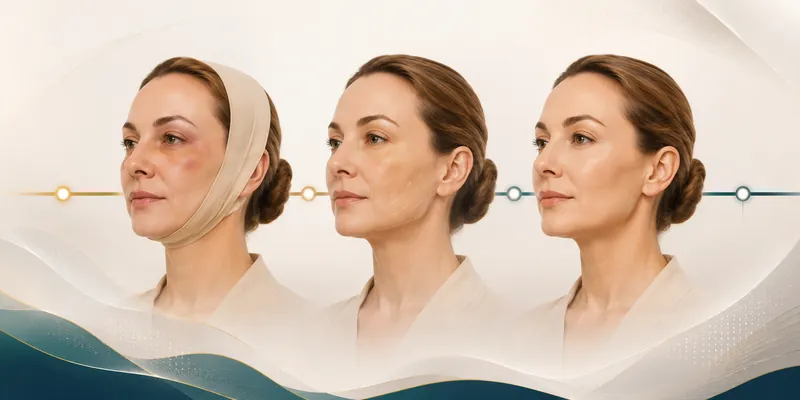
The First 48 Hours
The immediate post-operative period is the most medically managed phase. Most patients stay one night in the clinic or surgical facility after a SMAS or deep plane facelift; mini facelift patients are often discharged the same day.
- Day of surgery: Head wrapped in a compression bandage; drains in place if used (more common in SMAS and deep plane); drowsy from anaesthesia or sedation; rest only
- Day 1: Dressing and drain check; swelling beginning; pain typically mild to moderate, well-controlled with prescribed medication; head elevation (30–45°) required at all times — including while sleeping
- Days 2–3: Swelling peaks; bruising becomes visible (yellow-green-purple); this is the most visually alarming phase — it is expected and resolves. Cold compresses applied around the swollen areas (not directly on incisions) can reduce discomfort.
What to avoid in the first 48 hours: No bending forward, no straining or heavy lifting, no hot showers, no alcohol or blood-thinning medications, no sleeping on the face.
Week 1: What's Normal
The first week is largely about managing swelling, protecting incisions, and resting. Most patients are comfortable at home3 by days 3–4 but are not ready to be seen socially.
| Days | What to Expect | Key Instructions |
|---|---|---|
| Days 1–3 | Peak swelling, bruising appears, mild–moderate discomfort | Head elevation, cold compresses, prescribed analgesia |
| Days 3–5 | Swelling starts declining; skin may feel tight or numb; bruising darkens before fading | Gentle hygiene only; no strenuous activity; no sun exposure |
| Days 5–7 | First follow-up visit; some sutures removed; bruising fading to yellow-green | Surgeon reviews healing; compression garment worn continuously |
Numbness is normal. The skin of the face and neck will feel numb or hypersensitive after a facelift due to temporary disruption of superficial nerve fibres. This resolves gradually over 6–12 weeks in most patients. Persistent patches of reduced sensation are normal up to 6 months.
Tightness is normal. The sensation of pulling or tightness, especially when turning the head, is expected. It reflects normal wound healing and typically eases significantly by weeks 3–4.
Weeks 2–4: Return to Social Life
This phase brings the most noticeable improvement in appearance week-over-week. Bruising clears, swelling continues declining, and most patients cross the threshold of being comfortable in public.
| Week | Mini Facelift | SMAS Facelift | Deep Plane Facelift |
|---|---|---|---|
| Week 2 | Most bruising resolved; return to desk work possible; light social activities | Bruising mostly resolved; still swollen; presentable with makeup | Significant swelling still present; most patients remain at home |
| Week 3 | Socially presentable without makeup for most; light exercise begins | Return to desk work; socially comfortable with light makeup | Bruising resolved; major swelling declining; desk work possible |
| Week 4 | Near-normal routine; light gym work | Most socially presentable; light exercise | Socially comfortable for most; compression garment often discontinued |
Suture removal is usually complete by the end of week 2 (dissolvable sutures dissolve on their own). Scar lines are red and slightly raised at this stage — this is normal and is the beginning of the maturation process, not a sign of poor healing.
Months 2–12: Final Results & Scar Maturation
This is the phase most patients underestimate. The face looks significantly better from week 3–4 onward, but it continues improving for months afterward as residual swelling resolves in layers and scars mature.
- Month 2: Exercise resumes (most activities). Residual numbness improving but still present in patches. Scar lines fading from red to pink.
- Month 3: Most patients feel fully back to normal in daily life. Remaining swelling is usually in the neck and beneath the chin — often not visible to others but palpable to the patient.
- Month 4–6: Final contour emerges as the last of the deep swelling resolves. Sun protection on scars during this entire period is important — UV exposure can cause permanent hyperpigmentation.
- Months 6–12: Scars complete maturation — fading to a pale, flat, well-hidden line and reaching their final appearance. Any lingering firmness in the deeper tissues fully softens, and the result settles into its long-term state.
For deep plane facelifts, the full result is often not visible until month 4–6 because the deeper tissue remodelling takes longer to settle. Patients who assess their result at 6–8 weeks are evaluating an intermediate state. According to ASPS guidance, scars may take up to a year to fully refine.
When to Call Your Surgeon
Most facelift recovery is uneventful, but certain signs require immediate medical attention. Do not wait until your next scheduled appointment if you experience:
- Rapidly expanding swelling on one side only — asymmetric expansion, especially in the first 48–72 hours, is the key sign of haematoma (blood pooling). This is the most common serious complication2 and requires urgent drainage.
- Increasing pain after day 3 — pain should be declining, not increasing. Worsening pain after day 3 suggests infection or haematoma.
- Skin that looks dark, purple, or blistered — may indicate skin necrosis (tissue death), more common in smokers. Requires immediate assessment.
- Fever above 38°C / 100.4°F — may indicate infection.
- Sudden inability to close one eye or significant facial asymmetry in movement — possible nerve injury; requires assessment to determine if it is temporary (most commonly is) or requires intervention.
- Wound opening or heavy bleeding — apply gentle pressure and contact your surgeon or go to an emergency department.
Recovery by Procedure Type
| Milestone | Mini Facelift | SMAS Facelift | Deep Plane |
|---|---|---|---|
| Peak swelling | Day 2–3 | Day 2–4 | Day 3–5 |
| Bruising resolves | Week 1–2 | Week 2–3 | Week 2–3 |
| Return to desk work | Days 7–10 | Days 10–14 | Days 14–21 |
| Social presentability | Week 1–2 | Week 2–3 | Week 2–4 |
| Light exercise | Week 2–3 | Week 3–4 | Week 4–6 |
| Full exercise | Week 4–6 | Week 6–8 | Week 8 |
| Final result visible | Month 3–4 | Month 4–6 | Month 4–6 |
These are averages. Older patients, patients with thicker skin, and those with any post-operative complications may take longer at each milestone. Younger patients and mini facelift patients frequently recover faster than the averages shown.
Deep Plane Facelift Recovery — Detailed Guide Mini Facelift Recovery — What to ExpectFrequently Asked Questions
-
Most patients are socially presentable by 2–3 weeks. Final results — with all swelling resolved and scars matured — take 3–6 months. Mini facelift has the shortest downtime (1–2 weeks social); deep plane the longest (2–4 weeks). Individual healing varies significantly.
-
For desk work: mini facelift patients often return in 7–10 days; SMAS in 10–14 days; deep plane in 14–21 days. For physically demanding roles — anything involving lifting, bending, or significant exertion — add 2–4 more weeks to these estimates.
-
Swelling typically peaks on days 2–3 after surgery. It then declines gradually. Most visible swelling resolves within 2–3 weeks, but residual puffiness — especially in the neck and beneath the chin — can persist for 2–3 months before fully resolving.
-
Contact your surgeon immediately for: rapidly expanding swelling on one side only (possible haematoma), increasing pain after day 3, skin that looks dark or blistered (possible skin necrosis), fever above 38°C / 100.4°F, or significant asymmetry in facial movement. These require urgent assessment.