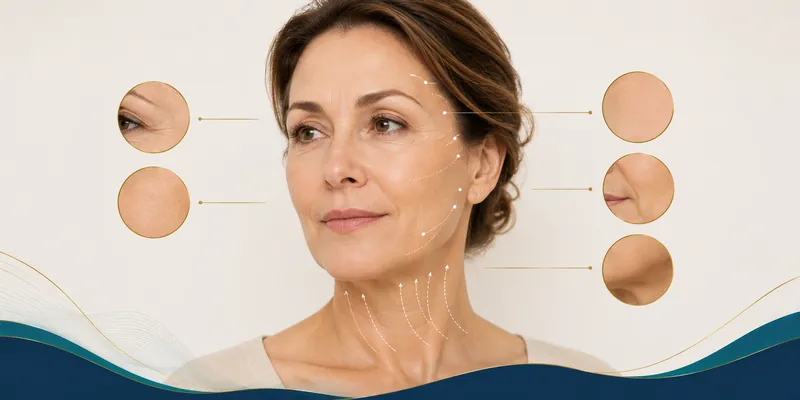
Ideal Age & Skin Quality
Most facelift patients are between 45 and 70 — ISAPS global survey data1 show the procedure is most commonly performed on patients aged 51–64 — but age is a guide rather than a rule. The relevant questions are about tissue quality and the nature of the ageing changes present:
- Skin elasticity: Some residual elasticity is needed for the skin to re-drape smoothly after repositioning of underlying structures. Completely inelastic, severely sun-damaged skin4 may not re-drape as well and may require additional skin procedures.
- Bone structure: Patients with good underlying bone structure — defined cheekbones, a strong jawline — tend to achieve the most natural-looking results. Bone loss from ageing can be addressed with concurrent filler or fat grafting.
- Degree of laxity: The technique is chosen based on how much and where laxity exists. Minor jowling and early neck laxity → mini facelift. Moderate to significant descent → SMAS. Severe midface descent, deep nasolabial folds, neck banding → deep plane.
Patients in their 40s increasingly opt for deep plane facelifts as a longer-lasting preventive measure — addressing early descent before it becomes severe. This is a valid approach and is reflected in the growing proportion of younger facelift patients in surgical data.
Deep Plane Facelift in Your 40s — Is It Too Early?Health Factors That Matter
A facelift is an elective surgical procedure. Surgeons conduct a pre-operative medical assessment to confirm the patient can undergo anaesthesia and surgery safely, in line with established facelift safety guidance2. Key factors evaluated:
| Health Factor | Why It Matters | What Surgeons Do |
|---|---|---|
| Smoking | Nicotine constricts blood vessels, dramatically increasing skin necrosis risk (tissue death due to poor circulation) and wound healing complications | Require cessation 4–6 weeks before and after; some decline smokers entirely |
| Hypertension (uncontrolled) | Elevated blood pressure is the primary risk factor for post-operative haematoma3 — the most common serious complication | Require controlled, stable BP before proceeding; may delay surgery |
| Blood clotting disorders | Abnormal clotting increases haematoma and bleeding risk significantly | Full clotting screen required; may be contraindication depending on severity |
| Blood thinners (warfarin, aspirin, NSAIDs) | Increase intraoperative and post-operative bleeding risk | Discontinuation 1–2 weeks pre-op (under physician guidance) |
| Diabetes | Impairs wound healing and increases infection risk; higher risk of complications | Well-controlled diabetes is acceptable; poorly controlled is a relative contraindication |
| Active autoimmune conditions | Conditions like lupus or Sjögren's affect wound healing and surgical risk | Assessed case by case; often requires specialist clearance |
| Recent major illness or surgery | Body resources depleted; increased anaesthetic risk | Typically wait minimum 6–12 months after major illness or significant surgery |
Medications to disclose: Tell your surgeon about every medication — including over-the-counter supplements. Fish oil, vitamin E, ginkgo biloba, and many herbal supplements affect clotting and need to be discontinued pre-operatively.
What Facial Concerns Does Facelift Address?
A facelift is specifically designed to address the structural consequences of facial ageing — descent and laxity of deeper tissue layers. It is not a treatment for surface-level changes.
| Concern | Facelift Addresses? | Better Alternative (if not) |
|---|---|---|
| Jowling (loose skin along jawline) | Yes — primary indication | — |
| Neck laxity and banding (platysma bands) | Yes — especially with neck lift component | — |
| Midface descent (sagging cheeks) | Yes — deep plane and mid-facelift | — |
| Deep nasolabial folds from tissue descent | Yes — partially, via repositioning | Fillers for residual depth |
| Fine lines and wrinkles | No — not a skin resurfacing procedure | Laser, chemical peel, RF microneedling |
| Skin texture, tone, pigmentation | No | Skin treatments, peels |
| Volume loss (hollow temples, cheeks) | Not primarily | Fat grafting or fillers — often combined with facelift |
| Upper eyelid hooding | No | Blepharoplasty (eyelid surgery) |
| Under-eye bags | No | Lower blepharoplasty |
| Forehead lines and brow descent | No | Brow lift, Botox |
Many patients combine a facelift with complementary procedures — blepharoplasty, fat grafting, or skin resurfacing — to address these additional concerns simultaneously. This can be efficient but also increases operative time and recovery demands. Each combination should be discussed with your surgeon in terms of safety and realistic staging.
Realistic Goals vs What Surgery Can't Do
The most common mismatch between expectation and outcome is patients expecting a facelift to make them look like a different person, rather than a more youthful version of themselves. A well-executed facelift should:
- Restore a more youthful structural appearance — jawline definition, cheek position, neck contour
- Be detectable only to those looking for it (when performed well)
- Look natural at rest and in motion — animation is a key test of surgical quality
- Last 7–15 years depending on technique and ongoing ageing
What a facelift cannot do:
- Stop the ageing process — the face continues to age after surgery
- Restore the face of a 30-year-old in a 60-year-old patient
- Compensate for significant volume loss without concurrent fat grafting
- Address concerns outside its anatomical scope (eyelids, forehead, skin texture)
Patients who come to surgery with clear, anatomy-based goals ("I want my jawline back, I don't like the neck banding") tend to be more satisfied than those with comparison-driven goals ("I want to look like I did at 40" or "like this celebrity"). Surgeons assess motivation and expectations as part of candidacy.
Which Technique Matches Your Needs?
| Your Concern | Likely Best Match |
|---|---|
| Early jowling, mild laxity (40s–early 50s) | Mini Facelift |
| Moderate jowling + neck, defined midface | SMAS Facelift |
| Significant midface descent + deep nasolabial folds + neck | Deep Plane Facelift |
| Cheek descent primarily, minimal neck concern | Mid-Facelift |
| Comprehensive ageing — face and neck together | Full Facelift |
| Mild laxity, not ready for surgery | Non-Surgical Options |
Questions to Ask in Consultation
A productive consultation should answer these questions — if a surgeon does not address them, ask directly:
- Based on my anatomy, which technique do you recommend — and why?
- What specific concerns can this procedure address, and which are outside its scope?
- Are there any health factors in my history that increase my risk?
- What is the planned anaesthesia approach, and why?
- How many of this specific procedure do you perform per year?
- What does recovery look like for someone with my anatomy and age?
- What are the most common complications, and what is your management protocol?
- Can I see before-and-after photos of patients with similar anatomy and concerns?
A surgeon who declines to answer these questions, rushes past them, or gives vague responses is a red flag regardless of price or reputation.
Frequently Asked Questions
-
There is no single ideal age. Most facelift patients are in their 40s–60s, but the deciding factor is tissue quality and the extent of facial ageing, not age alone. A healthy 45-year-old with significant laxity may be a better candidate than an unhealthy 65-year-old. Deep plane facelifts are increasingly performed in the 40s as a preventive approach.
-
Smoking significantly increases the risk of skin necrosis, wound healing failure, and infection. Most surgeons require patients to stop at least 4–6 weeks before surgery and for an equal period after. Some surgeons decline to operate on active smokers entirely. E-cigarettes and nicotine replacement products carry similar risks — disclose all use to your surgeon.
-
Significant weight fluctuations after surgery affect results — weight loss can reduce longevity, and weight gain can alter facial contour. Most surgeons prefer patients to be at a stable, realistic weight before operating. Obesity itself increases anaesthetic risk and affects the planned technique.
-
A facelift addresses jowling, neck laxity and banding, midface descent, and deep nasolabial folds caused by tissue descent. It does not address fine lines, skin texture, volume loss, or eyelid concerns — those require separate treatments such as skin resurfacing, fat grafting, or blepharoplasty.