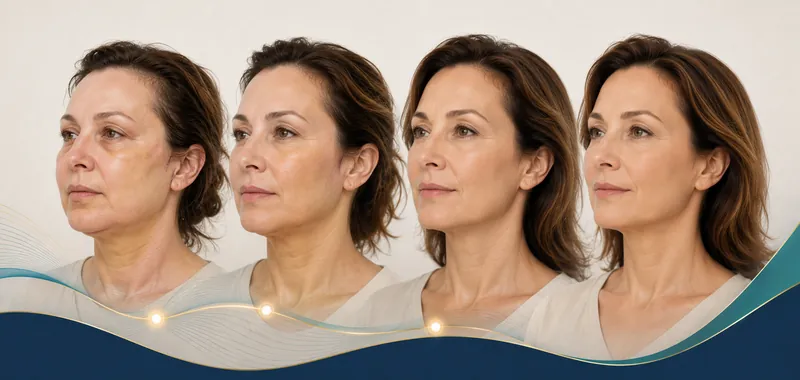
Recovery Timeline Overview
| Stage | Typical Appearance | Activity Level |
|---|---|---|
| Days 1–4 | Significant swelling, bruising, tightness; bandaging in place | Rest; head elevation; short walks only |
| Days 5–10 | Swelling peaks then begins to reduce; bruising most visible | Light activity; sutures removed days 5–7 |
| Weeks 2–3 | Bruising largely resolved; swelling still prominent | Light daily activities; no exercise |
| Weeks 3–4 | Visible improvement; most presentable in public | Desk work and social activities resume |
| Weeks 5–8 | Continued improvement; residual firmness and mild swelling | Light exercise returns; avoid high-impact |
| Months 3–6 | Residual swelling resolves; results become clearly visible | Full activity return; sun protection ongoing |
| 6–12 months | Final results; scars mature and fade | No restrictions |
Days 1–7: Immediate Recovery
The first week is the most physically demanding phase of deep plane recovery. Understanding what is normal makes it much more manageable.
Days 1–2: Post-Surgery
You will spend the first 1–2 nights in the clinic under nursing supervision. Expect: significant facial swelling, bruising developing around the eyes and neck, tightness across the face and jaw, and drainage tubes if placed (usually removed day 1–2). Pain is typically described as pressure and tightness rather than sharp pain, and is well-managed with prescribed medication. Rest with your head elevated at 30–45 degrees — this position is essential for reducing swelling throughout the first 2–3 weeks.
Days 3–5: Peak Swelling
Swelling peaks between days 2–4. This is the phase most patients find emotionally difficult — the swelling can be alarming in appearance, but it is normal and expected. Most of the visible swelling at this stage is fluid accumulation in the tissues; it does not reflect final results.
Gentle walks within the hotel or home are encouraged from day 3 to reduce DVT risk. Avoid bending forward, lifting anything heavier than a cup, or any straining — all increase intracranial pressure and can worsen swelling or trigger bleeding.
Days 5–7: Suture Removal
Most surgeons schedule a first suture removal appointment between days 5–7. Partial or full sutures are removed at this stage, and the wound is assessed for healing. Most patients feel significantly better by day 5–6 than at the peak swelling stage. Bruising remains prominent but begins to shift colour from purple-red toward yellow-green as it resolves.
Week 2: Swelling Begins to Resolve
By week 2, the most intense phase has passed. Bruising is resolving — most patients are at a yellow-green stage by days 10–12 and can be covered reasonably well with makeup by week 2. Swelling is still significant, particularly in the mid-face and around the jawline, but facial definition begins to re-emerge.
You may notice:
- Areas of numbness or altered sensation — this is normal and gradually resolves over weeks to months
- Tightness and a feeling of firmness across the cheeks and jaw — this softens progressively
- Occasional sharp, shooting sensations — nerve regeneration as sensation returns
- Itching around the incision lines — a sign of healing
Most patients managing remote or desk-based work can begin thinking about returning at the end of week 2, though week 3 is more realistic for feeling comfortable on screen.
Weeks 3–4: Social Recovery
This is the social recovery window — when most patients feel comfortable being seen by others, attending low-key social events, or returning to work-from-home roles. Visible bruising has typically cleared by week 3, and swelling has reduced enough that the results are beginning to become apparent — though the face still looks different from how it will at the six-month mark.
Continue to avoid:
- Strenuous exercise, heavy lifting, and high-impact activities
- Direct sun exposure to incision areas — UV exposure at this stage can cause permanent pigmentation changes in healing scars
- Alcohol in large quantities — dilates blood vessels and can increase swelling
Weeks 5–8: Activity Gradually Returns
By week 5–6, most patients can begin low-impact exercise: walking, light cycling, swimming (once wounds are fully healed). High-impact activities — running, weightlifting, contact sports — should wait until week 6–8 or as directed by your surgeon.
Residual swelling and firmness in the mid-face continue to improve during this phase. Many patients become impatient at this stage, as progress feels slow. Final results are not yet visible — what you see now is not the end point.
Months 3–6: Final Results Emerge
The most significant visual improvement often occurs between months 2–4, as residual deep swelling resolves and the repositioned deep-plane tissues settle into their final position.3 The face looks more natural and the tightness softens considerably.
Scars continue to mature and fade throughout this period and beyond. Most deep plane facelift scars are largely inconspicuous by 12 months, particularly when scar care protocols are followed.
Final results — the true outcome of the procedure — are best assessed at 6–12 months post-surgery.
What to Avoid and When
| Activity | Avoid Until | Reason |
|---|---|---|
| Bending forward / heavy lifting | Weeks 2–3 | Raises blood pressure; increases swelling and bleeding risk |
| Strenuous exercise | Weeks 6–8 | Elevates heart rate; risks wound complications |
| Direct sun on incisions | 6–12 months (use SPF 50) | Prevents permanent hyperpigmentation of scars |
| Alcohol | 2 weeks minimum | Dilates blood vessels; increases swelling |
| Smoking | Permanently (at minimum 6 months) | Severely impairs wound healing; raises complication risk |
| Sleeping flat | Weeks 2–3 | Head elevation reduces swelling |
| Makeup on incisions | Until wounds fully closed (typically week 2–3) | Infection risk |
Warning Signs: When to Contact Your Surgeon
Most symptoms in deep plane recovery are normal and expected. The following are not normal and require prompt contact with your surgeon:
- Sudden increase in pain or swelling on one side — may indicate a hematoma (blood collection), which requires urgent assessment2
- Skin discolouration (dark patches) developing rapidly — possible sign of tissue perfusion issues
- Fever above 38°C (100.4°F) — may indicate infection
- Wound opening or discharge that looks infected (yellow-green pus, odour)
- Inability to close one eye fully — requires assessment; temporary weakness is normal but should be monitored
- Persistent facial asymmetry beyond week 3–4 — some asymmetry is normal early on due to differential swelling; persistent unexplained asymmetry should be assessed
For a broader overview of recovery across all facelift types, see the facelift recovery timeline guide.