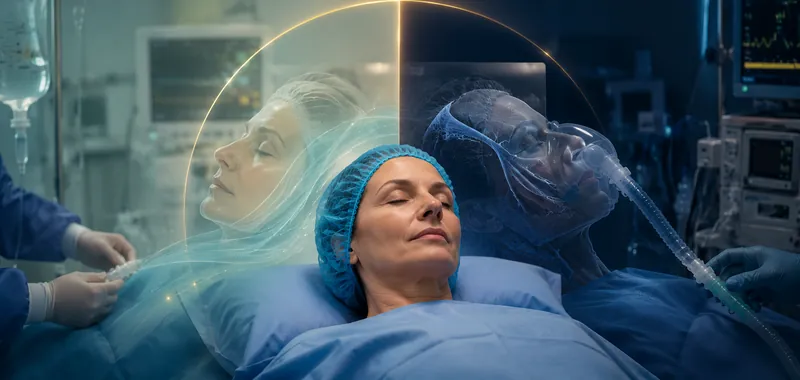
What Each Anesthesia Type Involves
Twilight Sedation (IV Sedation with Local Anesthetic)
Twilight sedation — also called monitored anesthesia care (MAC) or conscious sedation — involves intravenous medications that produce relaxation and reduced awareness. MedlinePlus describes sedation as different from full anesthesia because it does not usually make the patient completely unconscious.1
Local anesthetic is injected into the surgical area to block pain signals. The combination of IV sedation and local anesthetic allows the procedure to be performed without the patient requiring intubation or mechanical ventilation.
A trained anesthesiologist monitors the patient throughout, adjusting sedation depth. This is not the same as "local anesthetic only" — the anesthesiologist is present and actively managing the sedation level.
General Anesthesia
General anesthesia uses medicines that put the patient into a deep sleep-like state so they are unaware during surgery.2 An endotracheal tube may be placed after induction to secure the airway and allow controlled ventilation, depending on the case and anesthesiologist's plan.
General anesthesia is required when: the procedure is too long or complex for twilight sedation, when complete patient immobility is essential, when there are concerns about airway management, or when the patient has health conditions that make sedation without airway control inadvisable.
Side-by-Side Comparison
| Feature | Twilight Sedation | General Anesthesia |
|---|---|---|
| Airway | Unsecured; patient breathes independently | Secured with intubation |
| Consciousness | Sedated but not fully unconscious | Fully unconscious |
| Recovery from anesthesia | Faster — typically alert within 30–60 min | Slower — typically 1–2+ hours |
| Post-op nausea (PONV) | Lower risk | Higher risk (especially with volatile agents) |
| Throat soreness | None | Common — due to intubation |
| Airway control during surgery | Limited | Complete |
| Suitable for long procedures (4–6 hrs) | Less ideal | Yes — standard for long procedures |
| Risk of conversion needed mid-procedure | Small but present | Not applicable |
| Patient movement risk | Present; managed with sedation depth | None |
Risks of Twilight Sedation for Facelift
Twilight sedation is a well-established and generally safe approach when used with appropriate patient selection and monitoring. Its specific risks in facelift surgery include:
- Inadequate sedation depth: If the patient becomes more alert or uncomfortable than expected, the sedation may need to be deepened or converted to general anesthesia. This is managed by the anesthesiologist and is not dangerous when facilities and expertise are appropriate, but it is a potential interruption.
- Patient movement: A sedated (but not fully unconscious) patient may move during precise tissue work. This is a risk particularly relevant to deep plane surgery, where fine dissection near nerve structures occurs.
- Airway compromise: Without a secured airway, any obstruction (from sedation-induced relaxation of throat muscles, laryngospasm, or vomiting) requires immediate intervention. Trained anesthesiologists with appropriate equipment manage this — but it is a real distinction from general anesthesia.
- Under-estimated anxiety or pain: Some patients respond to twilight sedation differently. Patients with high anxiety or pain tolerance may not achieve adequate sedation depth with standard doses.
Risks of General Anesthesia for Facelift
General anesthesia in healthy elective surgery patients is very safe. The risks relevant to facelift include:
- Post-operative nausea and vomiting (PONV): More common with general anesthesia than twilight sedation. In facelift surgery, straining from vomiting can increase concern for hematoma, a recognized facelift complication, so PONV prevention is an important consideration in anesthetic planning.3
- Intubation-related effects: Throat soreness and hoarseness from the endotracheal tube are common and transient. More serious intubation complications are rare.
- Slower emergence: Full alertness after general anesthesia takes longer, which may affect how quickly a patient can be assessed neurologically post-operatively.
- Systemic risks: Cardiac events, awareness under anesthesia, and anaphylaxis are rare but not zero. Risk assessment is based on the patient's ASA classification and health history.
Which Anesthesia Is Used for Which Facelift Procedure?
| Procedure | Common Anesthesia | Notes |
|---|---|---|
| Mini facelift | Twilight sedation | Duration 1.5–2 hrs; most commonly done under twilight |
| SMAS facelift | General or twilight | Duration 2.5–4 hrs; surgeon and patient preference vary |
| Deep plane facelift | Usually general | Duration 4–6 hrs; general anesthesia more common for complex cases |
| Deep plane + neck lift combined | General anesthesia | Extended duration and complexity; general anesthesia standard |
| Mid-facelift (isolated) | Twilight or general | Varies by technique and duration |
Individual surgeon preference, facility capability, and patient health profile all influence this decision. Some experienced facelift surgeons perform deep plane procedures under twilight sedation with excellent outcomes — this is not universally standard but is practiced by specialists who have developed this approach.
Patient Factors That Affect the Anesthesia Choice
The anesthesiologist's pre-operative assessment weighs several factors:
- BMI: Obese patients may have reduced respiratory reserve and higher airway complication risk under sedation — general anesthesia with a secured airway may be safer
- Obstructive sleep apnea (OSA): Sedation without airway control carries higher risk; general anesthesia with intubation may be preferred
- Cardiovascular health: Patients with cardiac conditions are assessed for the physiological demands of each anesthesia type
- Anxiety: High-anxiety patients may not achieve adequate sedation with twilight dosing; general anesthesia avoids this uncertainty
- Prior anesthesia history: Previous PONV, difficult intubation, or anesthesia complications inform current planning
- Procedure duration and complexity: Longer, more complex procedures favour general anesthesia for sustained airway safety
See also: Twilight vs. general anesthesia: patient perspective guide and Is twilight sedation safe for facelift?