
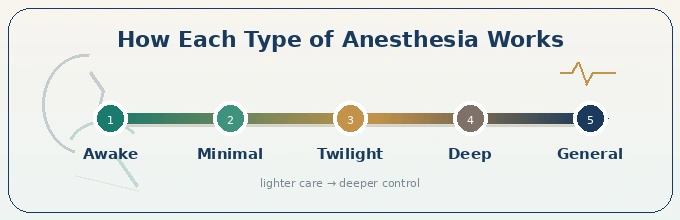
How Each Type of Anesthesia Works
Twilight Sedation (Monitored Anesthesia Care)
Twilight sedation — clinically called Monitored Anesthesia Care (MAC)1 or conscious sedation — combines intravenous (IV) sedatives with local anesthetic injected at the surgical site. You remain in a reduced state of consciousness: deeply relaxed, typically amnestic (little or no memory of the procedure), but not fully unconscious. You breathe on your own throughout.
- No breathing tube — protective airway reflexes remain intact
- Sedation depth continuously adjusted throughout the procedure
- Local anesthetic manages surgical pain; IV sedation manages anxiety and awareness
- Administered and monitored by an anesthesiologist or CRNA — not the surgeon
General Anesthesia
General anesthesia2 induces complete unconsciousness. You are entirely unaware, feel nothing, and have no memory of the procedure. A breathing tube is placed in the airway and you are connected to a ventilator for the duration of surgery. All protective reflexes are suspended.
- Complete unconsciousness — zero awareness possible
- Airway fully secured and controlled via intubation
- Breathing managed entirely by the anesthesiologist and ventilator
- Administered via IV medications and/or inhaled anesthetic gases
- Deeper physiological intervention with a correspondingly longer emergence period
Safety Profile Compared
Both approaches have excellent safety records in accredited facilities with qualified providers. The differences lie in the type and frequency of specific complications, not overall risk for healthy patients.
| Factor | Twilight Sedation | General Anesthesia |
|---|---|---|
| Airway | Patient breathes independently; no tube | Intubated; ventilator controls breathing |
| Intubation risks | None | Sore throat, dental injury, laryngospasm (rare) |
| Post-op nausea (PONV) | Lower incidence | Higher incidence — significant for facelift recovery |
| Aspiration risk | Lower (reflexes intact) with proper fasting | Managed via secured airway |
| Cardiovascular load | Less physiological stress | More complex medication management |
| Sleep apnea / obesity | Higher risk — airway may obstruct | Secured airway may be safer in these patients |
| Awareness during surgery | Possible at lighter depths; usually amnestic | Extremely rare with modern BIS monitoring |
An important nuance: twilight sedation is generally lower-risk for healthy patients. But for patients with obstructive sleep apnea, severe obesity, or certain cardiac conditions, general anesthesia with a secured airway can be the safer choice. Individual assessment — including a thorough pre-operative anesthesia evaluation4 — always matters more than a blanket recommendation.
Recovery Differences
Immediate Recovery (First 1–4 Hours)
After twilight sedation, most patients are alert within 1 to 2 hours. Nausea is less common and the transition from sedated to awake is typically smooth — many patients describe waking up as if no time passed, with no memory of the procedure.
After general anesthesia, emergence from full unconsciousness takes longer. Disorientation, grogginess, and nausea are more common in the first few hours. Intubation often leaves a sore throat lasting 1 to 2 days. Most patients are discharged from recovery within 2 to 4 hours but feel foggy considerably longer.
Why PONV Matters Specifically After a Facelift
Post-operative nausea and vomiting is more than a comfort issue after facelift surgery. Retching and vomiting raise blood pressure and create physical strain — both risk factors for hematoma (blood collecting under the skin), the most common serious early complication after a facelift. Twilight sedation's lower PONV rate3 is therefore clinically meaningful for this specific procedure type5, not just a quality-of-life benefit.
Which Anesthesia Is Used for Which Facelift?
Practice varies by surgeon, facility, and patient. There is no single standard — but clear patterns exist.
| Facelift Type | Common Anesthesia Choice | Notes |
|---|---|---|
| Mini facelift | Twilight sedation or local only | Shorter procedure (1.5–2.5 hrs); twilight well-suited |
| SMAS facelift | Twilight or general anesthesia | Either approach used routinely; surgeon preference varies |
| Deep plane facelift | General anesthesia (majority); twilight (some surgeons) | Longer duration (4–6 hrs); many prefer general for airway control during complex dissection |
| Extended deep plane | General anesthesia | Extended duration; general is standard |
| Combined facelift + neck lift | General anesthesia (most cases) | Longer combined procedure favors general |
Some experienced surgeons perform deep plane facelifts exclusively under twilight sedation with excellent results. Others consider general anesthesia essential for that level of surgery. Both approaches can produce safe outcomes when executed by experienced, well-equipped teams.
How to Discuss Anesthesia Options With Your Surgical Team
The anesthesia decision is medical, but you have a right and a responsibility to be informed. Your pre-operative anesthesia consultation — standard before any sedation procedure — is the place to have this conversation properly.
- Which approach do you plan for my procedure, and why? Understand the reasoning, not just the plan.
- Given my health history, are there factors favoring one approach? Discuss sleep apnea, obesity, cardiac history, prior adverse reactions.
- If twilight is planned — what's the contingency if conversion to general is needed mid-procedure? The facility must be equipped to convert; always ask this.
- What monitoring will be used throughout? Pulse oximetry, capnography, and EKG are standard for both approaches.
- How will post-operative nausea be managed? Anti-emetics are routinely used; worth confirming given the facelift-specific hematoma risk.
- Who will be administering and monitoring anesthesia? Should be an anesthesiologist or CRNA — not the surgeon alone.