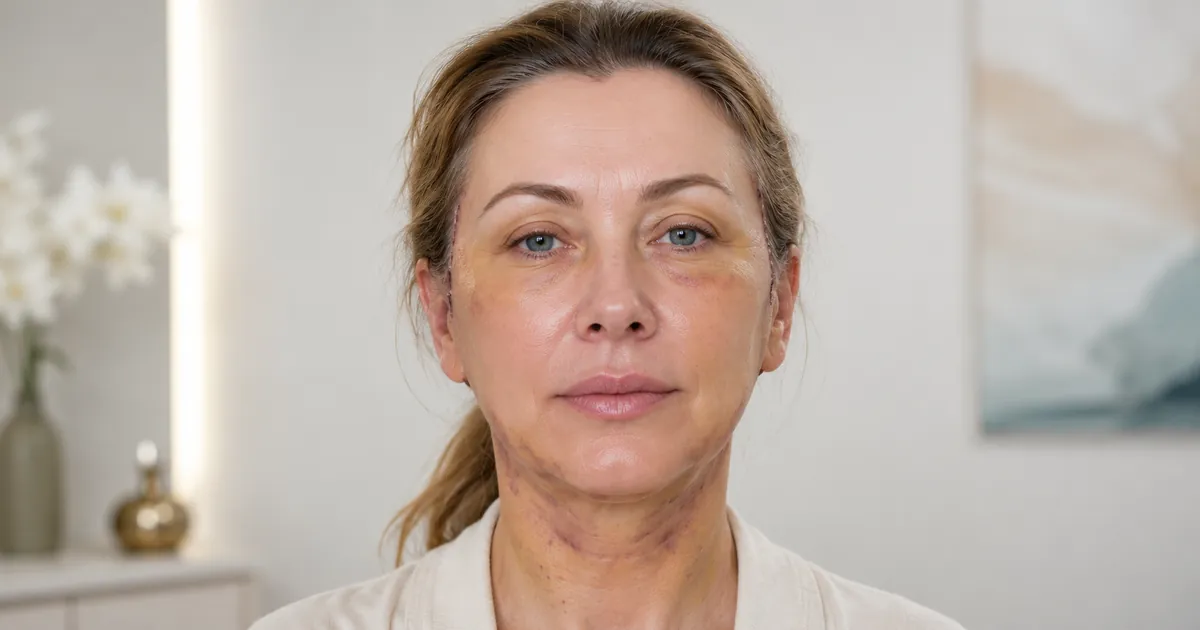
What the First Week Actually Looks Like
Days 1–3: Peak Swelling & Bruising
The first 72 hours are the most intense of recovery. A large outcomes analysis of 13,346 facelift patients1 confirms that early post-operative management is critical for minimising complications. Expect:
- Significant swelling — most pronounced on days 2–3, often asymmetric at first
- Bruising — typically purple or yellow-green; may track down the neck and chest due to gravity
- Tightness and pressure — more common than sharp pain; your compression bandage contributes to this sensation
- Drainage — if drains were placed, small amounts of serous (clear or light pink) fluid are expected
- Fatigue — your body is healing; rest is essential
Most surgeons recommend sleeping with your head elevated at 30–45 degrees for at least the first week to reduce swelling.4 Keep salt intake low and avoid activities that raise blood pressure.
Days 4–7: Swelling Settles, Incisions Visible
By day 4, swelling begins to decrease noticeably, though it is still significant. By day 7, many patients feel markedly better:
- Bruising continues to fade and shift colour (purple → green → yellow)
- Sutures or surgical staples may be partially removed at your follow-up visit
- Incision lines — in front of and behind the ears, possibly along the hairline — are visible as red lines; this is normal scarring at its earliest stage, not the final appearance
- Some areas of numbness or hypersensitivity are common along incision paths
Incisions & Early Scarring at One Week
At one week, incision lines will look red, possibly slightly raised, and may have some crusting. This is completely normal healing. What you see at one week is not the final scar — it will continue to mature and fade for 6–12 months.
Scar placement in a deep plane facelift is designed3 to be concealed: in front of the ear (following the natural crease), behind the ear, and along the posterior hairline. Well-placed, well-healed scars are typically very difficult to detect.
Facelift scars — placement, healing timeline, and careManaging Swelling, Bruising & Discomfort
- Head elevation: Sleep propped up at 30–45 degrees for at least 1–2 weeks
- Cold compresses: Use only with your surgeon's guidance — typically not directly on incisions
- Low sodium diet: Reduces fluid retention and swelling
- Avoid heat: Hot showers, saunas, and exercise elevate blood pressure and worsen swelling
- Pain medication: Take only as prescribed; avoid aspirin and NSAIDs unless specifically cleared by your surgeon
- No smoking: Nicotine severely impairs healing and significantly increases complication risk
Warning Signs — When to Call Your Surgeon
Contact your surgeon immediately if you experience any of the following:
- Sudden, rapid, one-sided swelling — hematoma can develop quickly after surgery; most common in the first 24–48 hours but can occur within the first week
- Severe or worsening pain not controlled by prescribed medication
- Fever above 38.3°C (101°F) — may indicate infection
- Abnormal discharge from incisions — pus, foul odour, or unusual colour
- Skin colour changes near incisions — darkening or blue/black discolouration may indicate poor blood supply
- Increasing rather than decreasing pain or swelling past day 4–5
Hematoma is the most common post-facelift complication, affecting approximately 1–3% of patients.25 When recognised early and treated promptly with surgical drainage, it typically does not affect the final result.
Deep plane facelift complications in detailWhat to Expect Beyond Week One
Week one is often the most uncomfortable part of recovery, but also the most temporary. By weeks 2–3, most visible bruising will have faded and most patients feel comfortable being seen in public. Full results develop gradually over 3–6 months — what you see at one week tells you almost nothing about the final outcome.
| Timeframe | What to Expect |
|---|---|
| Week 1 | Peak and declining swelling; bruising; suture removal begins |
| Weeks 2–3 | Most bruising gone; comfortable in public; still some swelling |
| Weeks 4–6 | Residual puffiness; light exercise permitted; results forming |
| Months 3–6 | Swelling fully resolved; scars fading; final result emerging |
| Months 6–12 | Scars nearly invisible; complete result visible |