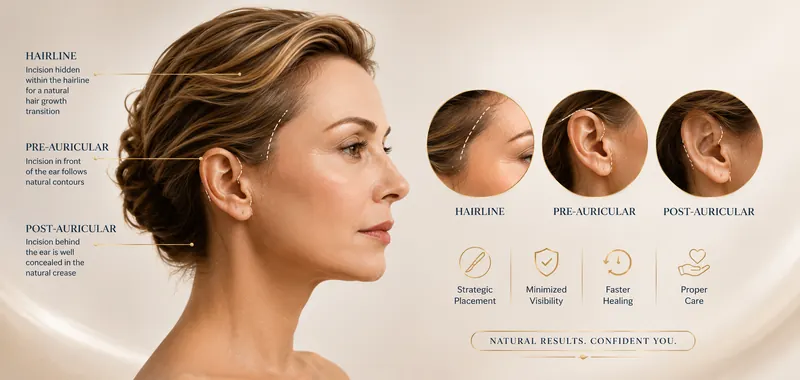
Where Facelift Incisions Are Placed
Facelift incisions follow a path designed to conceal within natural anatomy, as outlined in ASPS facelift procedure guidance1. The standard incision route for a full facelift:
- Temporal hairline: Begins 1–2 cm inside the scalp hairline above the ear, where it is hidden by hair
- Pre-auricular (in front of the ear): Runs downward along the natural crease between the cheek skin and ear cartilage. Surgeons place incisions along natural skin tension lines4; they choose between pre-tragal placement (in the crease in front of the tragus) or retro-tragal placement (just inside the tragus) — retro-tragal placement leaves a less visible scar in the right patient
- Around the earlobe: Curves smoothly under and around the lobule — this is one of the most visible areas early on and a key test of surgical precision
- Post-auricular (behind the ear): Continues up the crease behind the ear and into the scalp — concealed by the ear itself and the hairline
- Posterior scalp: Ends within the hair-bearing scalp — not visible in normal hair wear
If a neck lift or submentoplasty is combined, a small additional incision is placed under the chin within the natural sub-mental crease — typically not visible once healed.
Annotated: full facelift incision path from temporal hairline to post-auricular scalp
Scar Placement by Technique
| Technique | Incision Length | Key Difference |
|---|---|---|
| Mini facelift | Shorter — typically stops at or behind the earlobe | Reduced post-auricular component; smaller overall scar burden |
| SMAS facelift | Standard — full pre- and post-auricular route | Classic full incision; well-established healing pattern |
| Deep plane facelift | Standard to slightly extended | Same external path as SMAS; deeper tissue work doesn't change incision placement |
| Mid-facelift | Variable; some approaches use temporal or intraoral access | Some techniques avoid ear incisions |
Month-by-Month Healing Timeline
| Stage | Typical Appearance | Key Activity |
|---|---|---|
| Weeks 1–2 | Closed wound lines; crusting possible; some ooze normal | Keep clean as instructed; no topical products yet |
| Weeks 3–4 | Pink lines; may feel slightly firm or itchy | Wounds typically fully closed; begin silicone from week 3–4 |
| Weeks 5–8 | Pink, possibly slightly raised; most visually prominent stage | Continue silicone; SPF 50 on any exposed areas; avoid sun |
| Months 2–4 | Still pink but beginning to flatten; less noticeable | Continue silicone; add gentle scar massage |
| Months 4–9 | Progressively lighter; losing pink colour; flattening | Continue SPF; silicone can be reduced to once daily |
| Months 9–18 | Pale, flat, at or below skin surface; largely inconspicuous | Maintain SPF; assess for any ongoing care needs |
| 18+ months | Final appearance; most scars essentially invisible | No restrictions; ongoing SPF recommended long-term |
Evidence-Based Scar Care After Facelift
1. Sun Protection (SPF 50) — Most Important
UV exposure is the most reliably harmful thing for a healing scar. Even brief unprotected sun exposure within the first 12 months can cause permanent hyperpigmentation — permanent darkening of the scar that does not fade over time, even when later protected. Apply SPF 50 (broad-spectrum, mineral or chemical) to all scar areas daily — including incidentally through windows — for the first 12 months. This is non-negotiable.
2. Silicone Gel or Sheets
Silicone is the most evidence-supported non-prescription topical scar intervention. It works by creating an occlusive environment that maintains hydration and modulates collagen production, reducing scar height and redness. Apply silicone gel (2x daily) or silicone sheets (8–12 hours per day) from week 3–4 when wounds are fully closed and no longer scabbed. Continue for 3–6 months consistently for best results. Both gel and sheets are effective; gel is easier for the irregular contours around the ear.
3. Gentle Scar Massage
From week 4–6 onward (once wounds are fully healed), gentle circular massage of the scar area helps soften thickening, break down early fibrotic tissue, and prevent the scar from tethering to deeper structures. 2–3 minutes of gentle massage, twice daily, using a small amount of unscented moisturiser or silicone gel. Do not massage any area that is still scabbed, open, or not fully healed.
4. What Doesn't Have Strong Evidence
Vitamin E oil is widely used but poorly supported by clinical evidence — some patients develop contact dermatitis from it. Natural oils (rosehip, coconut) are not harmful but are not proven scar treatments. Onion extract (Mederma/Contractubex) has inconsistent evidence. Focus on SPF and silicone as the foundation of your scar care.
What Affects Facelift Scar Quality
Surgeon Technique (Primary Factor)
The single most important determinant of scar quality is how much tension is placed on the skin at closure. High-tension skin closure stretches over time and produces widened, visible scars. Experienced facelift surgeons redistribute tension to deeper layers (SMAS, platysma) so that the skin is closed with minimal tension. This is the primary reason surgeon experience significantly affects scar outcomes.
Incision placement also matters — whether the pre-auricular incision is placed in the natural crease or slightly outside it, whether the temporal incision stays within the hairline, and whether the posterior hairline is respected rather than shifted — all affect how visible scars are in normal wear.
Individual Healing Response
Genetics determine how individuals scar. Patients prone to hypertrophic or keloid scarring are at higher risk for visible facelift scars. This should be discussed before surgery — some surgeons modify their technique or plan for proactive scar management in high-risk patients.
Skin Tone
Patients with darker skin tones (Fitzpatrick IV–VI) have higher baseline risk of post-inflammatory hyperpigmentation and hypertrophic scarring. Sun protection is particularly important for these patients, as is discussion of skin type with the surgeon before surgery.
Smoking
Smoking impairs blood flow to wound edges and significantly reduces healing quality. Patients who smoke have higher rates of wound dehiscence3 (wound opening) and poor scar outcomes. Stopping smoking at least 4 weeks before surgery — and permanently if possible — is strongly advised.
Identifying Problem Scars
Most facelift scars heal without issue. The following are signs of potentially problematic scarring2:
- Widening scar beyond week 6–8: Suggests excessive tension at closure — discuss with your surgeon
- Raised, firm, itchy scar at 3+ months: May be hypertrophic scarring — typically responds to steroid injections or silicone pressure therapy
- Keloid formation: Scar extending beyond original incision edges — requires specialist assessment; occurs most commonly in predisposed patients
- Visible scar outside natural anatomy: Hairline shifting, tragal distortion, or scarring in an unusual location — a surgical technique issue, discussed with surgeon after 12-month maturation
- Permanent dark discolouration: Often the result of early sun exposure on healing scars — preventable but difficult to reverse
Scar Revision Options
If a scar remains unsatisfactory at 12–18 months after full maturation, revision options include:
- Direct excision and re-closure: The scar is excised and re-closed with careful attention to tension and layered closure — appropriate for widened or displaced scars
- Laser resurfacing: Fractional laser can improve scar texture, colour, and surface irregularity
- Steroid injections: For hypertrophic scarring — reduces height and firmness
- Fat grafting: For depressed or tethered scars — adding volume beneath the scar can improve the surface contour
Scar revision is considered no sooner than 12 months post-surgery, as some scars that appear problematic at 6 months improve significantly with time.