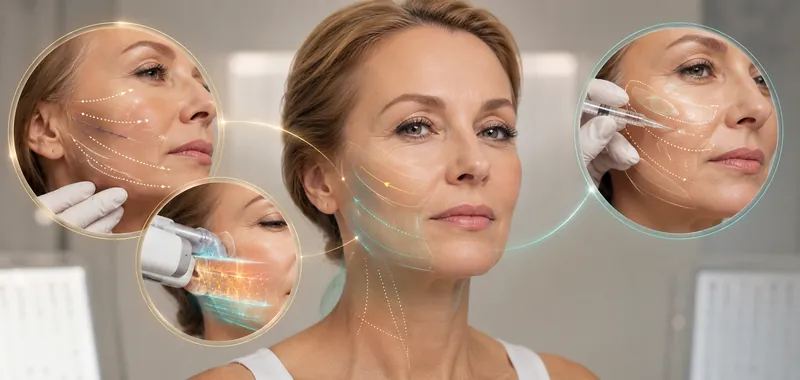
What a Facelift Actually Does — and Why It Matters for Alternatives
To understand what non-surgical treatments can and cannot do, it helps to understand what facelift surgery does. A facelift physically repositions facial soft tissues — the SMAS layer, fat compartments, and in deep plane surgery the deeper ligamentous attachments — back to a higher, more youthful anatomical position. It also removes excess skin laxity that has developed as a result of this descent.
This is a structural correction. The jowl — which is the cheek fat pad that has slid below the jawline — is lifted back. The descended mid-face — which creates deeper nasolabial folds and under-eye hollowing — is repositioned upward. This cannot be replicated by tightening the skin or adding volume; it requires physically moving the tissue.
Any honest assessment of non-surgical alternatives must start with this understanding. Treatments that do not physically reposition tissues cannot reproduce this result — they can improve adjacent concerns, but they address different aspects of facial aging.
Thread Lift
Thread lifts4 involve inserting dissolvable sutures (usually PDO — polydioxanone) under the skin, which are then tensioned to lift soft tissues. They provide the closest approximation to a surgical lift1 without incisions.
What They Can Do
- Provide a modest lift to jowls and mid-face in patients with mild laxity
- Stimulate some collagen production as the threads dissolve
- Require no incisions and minimal downtime (1–3 days)
- Provide a temporary improvement that helps patients understand what a lift would achieve
Limitations
- Results last 1–2 years; threads dissolve and must be repeated
- Degree of lift is significantly less than surgical facelift
- Not appropriate for significant laxity — insufficient purchase in loose tissue
- Complications (thread migration, puckering, infection) are uncommon but real
- Accumulated cost over time can rival facelift surgery
Best For
Very mild early jowling or mid-face descent in patients not ready for or unsuitable for surgery. A reasonable interim option or complement to other treatments. Not a replacement for facelift in patients with established laxity.
HIFU (High-Intensity Focused Ultrasound) — Ultherapy
HIFU delivers focused ultrasound energy to the SMAS layer (the same layer targeted in facelift surgery) at precise depths below the skin surface. The thermal injury triggers collagen remodelling3 and gradual tightening.
What It Can Do
- Stimulate collagen production in the skin and SMAS layer
- Produce modest tightening in patients with early laxity
- Improve skin quality and texture
- No downtime; non-invasive
Limitations
- Results are modest — clinically relevant tightening typically seen in patients with mild laxity; minimal effect on significant ptosis
- Results develop gradually over 2–6 months after treatment
- Significant discomfort during treatment
- Results last 12–18 months; maintenance treatments required
- Often over-marketed relative to what it reliably achieves in peer-reviewed evidence
Best For
Patients with early skin laxity wanting to delay rather than avoid surgery. Also useful as maintenance after facelift surgery to slow re-aging of the skin layer.
Radiofrequency Treatments (Thermage, Morpheus8)
Radiofrequency (RF) technology delivers thermal energy to heat dermal and subdermal tissues, stimulating collagen production. Monopolar RF (Thermage) treats larger areas; fractionated microneedling RF (Morpheus8) combines microneedling with RF energy for deeper penetration.
What They Can Do
- Improve skin laxity and texture through collagen remodelling
- Reduce submental fullness (double chin) — Morpheus8 particularly effective here
- Provide more targeted improvement than surface-only treatments
- Minimal to no downtime (Thermage); 3–5 days downtime for Morpheus8
Limitations
- Do not physically reposition tissues — improvement is through skin tightening, not tissue lifting
- Multiple sessions typically required for best results
- Results last 12–24 months with maintenance
- Less effective on significant structural laxity
Best For
Skin quality improvement, early jowl softening, and submental tightening. Useful in combination with other non-surgical treatments and as surgical maintenance.
Dermal Fillers
Hyaluronic acid fillers2 and biostimulators (Sculptra, Radiesse) restore facial volume and can improve the appearance of nasolabial folds, under-eye hollowing, and mid-face deflation.
What They Can Do
- Restore volume to the mid-face, temples, and under-eye area
- Reduce the appearance of nasolabial folds caused by volume loss (not ptosis)
- Improve jawline definition when used for structural support
- Results are immediate; downtime minimal
Limitations
- Fillers add volume — they do not lift or reposition descended tissues
- Nasolabial folds deepened by mid-face descent (not volume loss) are not improved by filler; they may worsen if over-filled
- Repeated large-volume filling over years can produce an unnatural, over-volumised appearance
- Not appropriate as a substitute for surgery in patients with established structural laxity
- Results last 12–18 months; ongoing cost
Best For
Volume replacement in patients with deflation as the primary concern. Excellent complement to facelift surgery (which addresses structure, not volume). Should not be used to compensate for laxity.
Combination Approaches
Most practitioners working with non-surgical facial rejuvenation use combinations of treatments tailored to the individual. A common non-surgical approach for early aging might include: RF or HIFU for tightening, hyaluronic acid filler for volume, and skincare or laser for surface quality. Thread lift can be added for mild lift when appropriate.
These combinations can produce genuinely satisfying results for patients with early changes — but ongoing maintenance sessions and cumulative costs are a reality. Over a 10-year period, non-surgical maintenance can exceed the cost of a single surgical procedure.
Non-Surgical vs. Facelift Surgery: Honest Comparison
| Non-Surgical (Best Options) | Facelift Surgery | |
|---|---|---|
| Tissue repositioning | No | Yes |
| Effect on jowls | Modest (thread) to minimal | Significant |
| Effect on mid-face descent | Modest (thread) to minimal | Significant (especially deep plane) |
| Effect on neck laxity | Limited | Significant (with neck lift) |
| Duration of results | 1–2 years (maintenance required) | 7–12+ years |
| Recovery time | None to 3–5 days | 2–4 weeks (social) |
| Risk profile | Low | Low-moderate (significant complications rare) |
| Appropriate for mild changes | Yes — often the right choice | Often over-treatment |
| Appropriate for significant laxity | No — insufficient effect | Yes |
Who Benefits From Non-Surgical Options?
Non-surgical treatments are genuinely appropriate for:
- Patients in their early 40s with mild laxity who are not yet surgical candidates
- Patients who want to delay surgery and maintain their current appearance
- Post-surgical patients maintaining their facelift result
- Patients for whom surgery is medically inadvisable
- Patients whose primary concern is volume loss or skin quality — not structural descent
Non-surgical treatments are not appropriate as a substitute for facelift when:
- Moderate to significant jowling is present
- Established mid-face descent and deep nasolabial folds from tissue ptosis
- Significant neck laxity and platysmal banding
- The patient wants durable results that don't require ongoing quarterly treatments
Cost Comparison: Non-Surgical vs Surgical
Non-surgical treatments have lower upfront costs but require ongoing maintenance. Over time, cumulative spending can rival or exceed the cost of a single facelift:
| Treatment | Cost per session | Frequency | 10-year total |
|---|---|---|---|
| Thread lift | $2,000–$4,500 | Every 1–2 years | $10,000–$45,000 |
| HIFU (Ultherapy) | $2,000–$5,000 | Every 12–18 months | $14,000–$40,000 |
| Dermal fillers | $1,500–$4,000 | Every 12–18 months | $10,000–$35,000 |
| RF (Morpheus8) | $1,500–$3,500 | Every 12–24 months | $7,500–$35,000 |
| Facelift surgery | $8,000–$30,000 | Once (lasts 7–12+ years) | $8,000–$30,000 |
For patients with established laxity, a single facelift — with results lasting 7–12+ years5 — typically provides better value per year of results than repeated non-surgical maintenance. For patients with mild early changes, non-surgical treatments can be cost-effective while delaying surgery.
See our complete cost guide for surgical pricing by country.
When to Consider Surgery Instead
Non-surgical treatments reach their limits when:
- Jowling is established: Visible jowl formation along the jawline that cannot be meaningfully lifted by threads or tightened by energy devices
- Mid-face descent is moderate to significant: Deepening nasolabial folds from tissue ptosis (not volume loss) — fillers cannot correct descent-related folds
- Neck laxity is visible: Loose skin, platysmal banding, or submental fullness that non-surgical treatments cannot adequately address
- Maintenance fatigue: The patient is spending significant time and money on repeated treatments that produce diminishing returns
- Results plateau: Non-surgical treatments are no longer producing noticeable improvement
If two or more of these apply, a consultation with a board-certified facelift surgeon is the appropriate next step — not another round of non-surgical treatment.