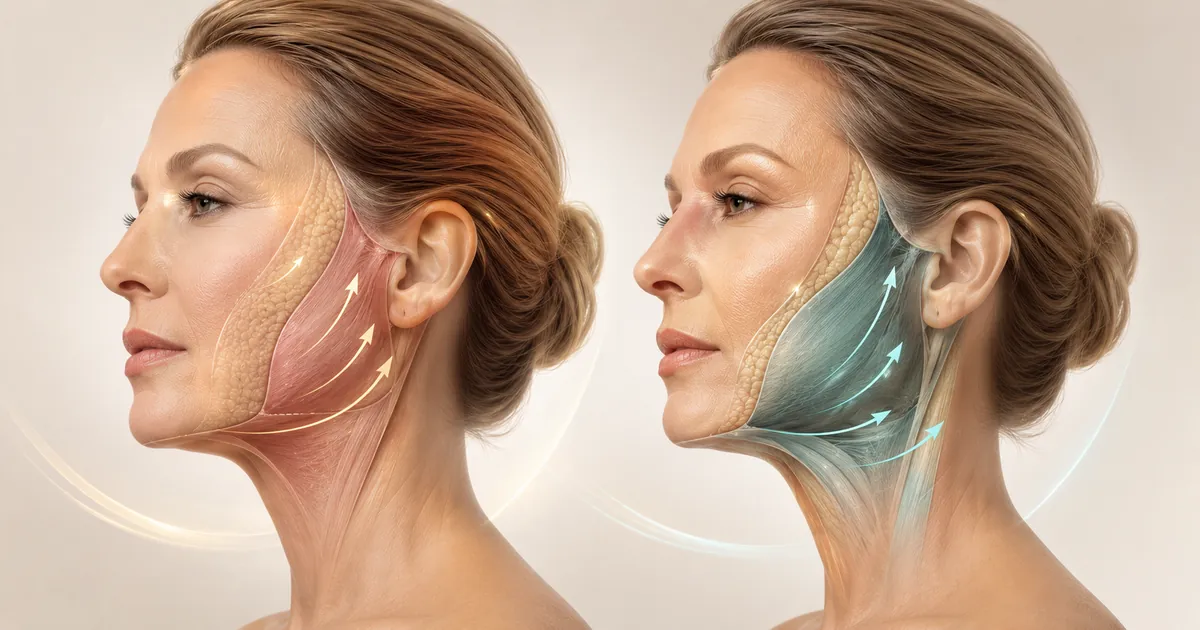
The Key Anatomical Difference
Both procedures address the SMAS1 (Superficial Musculoaponeurotic System) — the fibrous muscular layer between the skin and deeper facial structures. The difference is how.
In a SMAS facelift, the surgeon works on top of or within the SMAS itself. The SMAS is either plicated (folded and sutured to tighten it), imbricated (overlapped), or partially excised. The skin and SMAS are tightened and repositioned, but the deeper retaining ligaments remain intact.
In a deep plane facelift, the surgeon dissects below the SMAS2 — into the "deep plane" — and releases the retaining ligaments that anchor the facial tissue in its descended position. This allows the entire composite unit (SMAS + fat + overlying skin) to be lifted and repositioned as one piece, rather than in separate layers.
The clinical consequence: deep plane produces more vertical repositioning of the midface4 — the malar fat pad, nasolabial folds, and cheek volume — which a SMAS facelift cannot fully address without going to this deeper level.
Side-by-Side Comparison
| Feature | SMAS Facelift | Deep Plane Facelift |
|---|---|---|
| Dissection level | On or within SMAS | Below SMAS — deep plane |
| Ligament release | Partial or none | Full release (zygomatic, masseteric) |
| Midface correction | Limited | Comprehensive — repositions malar fat pad |
| Nasolabial fold improvement | Indirect / modest | Direct — significant improvement |
| Skin tension | Moderate | Minimal — tissue moves as one unit |
| Operating time | 3–4 hours | 4–6 hours |
| Social downtime | 2–3 weeks | 2–4 weeks |
| Results longevity | 7–12 years | 10–15 years |
| Surgeon availability | Most facial plastic surgeons | Specialist subset only |
| Relative cost | Lower | Higher (more complex, longer OR time) |
Results & Longevity
For the right patient, results from both techniques can look equally natural. The difference lies in comprehensiveness and longevity.
A well-executed SMAS facelift can produce excellent results for lower-face and jawline aging without significant midface descent. The limitation appears when the midface (cheeks, nasolabial folds) is the primary concern — here, SMAS techniques are less effective because they work above the retaining ligaments.
Deep plane results are generally considered more comprehensive for patients with significant midface descent because the vertical repositioning addresses the root structural cause. Prospective outcome data5 supports that results also last longer — typically 3–5 years more — because the tissue has been fundamentally repositioned rather than tightened from above. SMAS facelift longevity studies report durable results in the 7–12 year range3.
| Concern | SMAS Facelift Result | Deep Plane Result |
|---|---|---|
| Jowling | Excellent | Excellent |
| Neck laxity (with neck lift) | Excellent | Excellent |
| Lower face definition | Excellent | Excellent |
| Midface descent | Limited | Comprehensive |
| Nasolabial folds | Modest indirect improvement | Significant direct improvement |
| Malar fat pad repositioning | Minimal | Yes — restores cheek volume position |
Recovery Comparison
Both techniques share similar post-operative experiences — the deep plane is slightly more involved because the dissection is more extensive.
| SMAS Facelift | Deep Plane Facelift | |
|---|---|---|
| Peak swelling | Days 2–4 | Days 2–4 (typically more pronounced) |
| Bruising resolution | 10–14 days | 10–21 days |
| Social downtime | 2–3 weeks | 2–4 weeks |
| Return to exercise | 4–6 weeks | 6–8 weeks |
| Final result visible | 3–6 months | 3–6 months |
| Pain levels | Mild–moderate; well controlled | Similar — not significantly more painful |
Cost Comparison
Deep plane facelifts cost more than SMAS procedures because they require greater surgical skill, longer operating time, and are performed by fewer surgeons.
| Location | SMAS Facelift | Deep Plane Facelift |
|---|---|---|
| United States | $10,000–$18,000 | $15,000–$30,000+ |
| United Kingdom | £9,000–£16,000 | £12,000–£22,000 |
| Turkey | $4,000–$7,000 | $6,000–$12,000 |
Who Benefits Most From Deep Plane?
Deep plane is the better choice when:
- Significant midface descent — flattened cheeks, descended malar fat pad
- Deep nasolabial folds — pronounced smile lines that SMAS cannot fully address
- Advanced aging — significant ligament laxity requiring structural release
- Long-term thinking — patient wants the most durable result possible
- Prior SMAS facelift — secondary procedures often need the deeper approach to release scar tissue
Who Is SMAS Right For?
A SMAS facelift delivers excellent results when:
- Aging is primarily in the lower face and neck with minimal midface descent
- Patient is earlier in the aging process — good tissue quality and less ligament laxity
- Recovery time is a priority — slightly shorter downtime than deep plane
- Access to a deep plane specialist is limited — a skilled SMAS surgeon produces better results than an inexperienced deep plane surgeon
- Budget considerations — SMAS is a more accessible price point
An important caveat: surgeon skill matters more than technique. A highly experienced SMAS surgeon will consistently outperform an inexperienced deep plane surgeon. The technique is only one factor — the surgeon performing it is the most important.